

What Are Custom Corrugated Shipping Boxes?
A custom corrugated shipping box — most commonly a Regular Slotted Container (RSC) — is a folding carton made from corrugated fibreboard: two flat liner sheets glued to a fluted paper core. That flute is the engineering secret. It works like the arch in a bridge, converting vertical stacking loads into compression along the paper edges, which is why a 400-gram carton protects 20 kg of product through a 12,000 km sea journey. Unlike folding cartons or die-cut display boxes, a standard RSC needs no cutting die and no mould: the box geometry is defined by a slotting specification on the corrugator. That is why we can offer a 500-piece MOQ per size and why changing your box size next season costs nothing in tooling — we simply revise the spec.

Two things make a shipping box “custom”: size and print. We cut to your internal dimensions (length × width × depth) so your product, its inner packaging and its cushioning all fit with minimal void — oversized boxes waste board, void fill and freight, all three of which you pay for. And we print your logo, handling marks and shipping information in 1–2 flexo colours as standard, which turns the cheapest packaging in your supply chain into the most-seen advertisement your brand owns: the box that arrives at your customer’s warehouse or doorstep.


How Strong Is “Strong Enough”? ECT vs Burst Strength
Corrugated board is graded two ways and they answer different questions. ECT (Edge Crush Test) measures how much stacking compression the board edge survives — this is the number that matters when boxes are palletised and stacked. Burst strength (e.g. 200#, 250#) measures puncture and tear resistance — this matters when boxes are handled individually and pushed across warehouse floors. A common beginner mistake is buying “250# burst” board for a palletised load that actually needed 32 ECT, paying more for a property the shipment never uses.
| Board grade | ECT | Flute | Practical load (with normal stacking) | Best for |
|---|---|---|---|---|
| Single wall economy | 26 ECT | B | ~10 kg | Light e-commerce parcels, inner cartons |
| Single wall standard | 32 ECT (≈200#) | C | 15–20 kg | The export workhorse — most orders land here |
| Single wall heavy | 44 ECT | C | 20–25 kg | Mixed heavy loads, tall stacks |
| Double wall | 48–51 ECT (≈275#–350#) | BC | 25–40 kg | Machinery, ceramics, glass jars, long sea routes |
| Moisture-resistant | 32+ ECT | C/BC | — | Humid climates, LCL shipments, condensation risk |
Box Styles We Manufacture
| Style | Construction | Best for | Relative cost |
|---|---|---|---|
| RSC — Regular Slotted Container | All flaps equal length, meet at centre | General export, master cartons, pallets — the default choice | Lowest |
| HSC — Half Slotted Container | RSC without top flaps; open-top with lid/tray option | Shallow products, tray-packed goods, display-then-ship | Low |
| FOL — Full Overlap | Outer flaps fully overlap for double-thickness top and bottom | Heavy or fragile contents needing extra flap strength under the tape | Medium |
| Die-cut / mailer style | Custom cutting die; tabs, locks, handles, windows | Distinctive unboxing, retail-ready shipping | Higher (die required) |
| Double-wall telescoping | Separate top and bottom, slide over each other | Very tall or very heavy items, two-piece packing | Medium-high |
| Five-panel wrapper | Board wraps fully around the product | Long narrow items: extrusions, tubes, framed goods | Low |
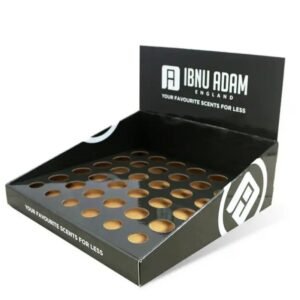
Differentiation note: if you need a box that displays on a shelf rather than one that ships, see our PDQ counter display boxes (MOQ 100) — same corrugated family, different job. For branded gift packaging, our litho-laminated gift boxes put photo-quality print onto corrugated strength.
Flute Selection — The Profile Decides the Job
| Flute | Height | Flutes/metre | Strength profile | Printing surface | Typical use |
|---|---|---|---|---|---|
| F | 0.8 mm | ~125 | Light, thin, stiff | Excellent | Pizza-style boxes, laminated retail cartons |
| E | 1.5 mm | ~100 | Thin, good crush | Very good | Retail-ready small boxes, litho-lamination base |
| B | 3.0 mm | ~75 | Good puncture resistance | Good | Canned goods, die-cut inner fits |
| C | 4.0 mm | ~65 | Best all-round compression | Fair | Standard export RSC — the default |
| BC double wall | 7.0 mm | — | High compression + puncture | Fair | Heavy export, fragile, long-haul sea freight |
The rule that surprises buyers: finer flutes print better, larger flutes carry more — and for shipping boxes, carrying usually wins, which is why C-flute kraft is the industry default. When a customer needs both (a heavy box that also looks great), the answer is not a compromise flute; it is litho-lamination: print the artwork on fine E-flute, then laminate it to a strong BC wall.
Size Guide — How to Specify Your Box
Corrugated boxes are always quoted in internal dimensions, stated as Length × Width × Depth (depth = the opening direction). Measure the largest unit you will pack — the product plus its inner box, bag and any cushioning.
| Step | What to do |
|---|---|
| 1 | Measure product (or packed bundle) L × W × H in mm with a tape, not by eye |
| 2 | Add 3–6 mm per side for a snug fit; 6–12 mm per side if the product ships with inner packaging or a liner |
| 3 | Depth = product height + top/bottom cushioning (void fill, dividers, trays) |
| 4 | Remember board thickness is outside your internal spec — a C-flute wall adds ~4 mm per face, so the outer box is ~8–10 mm larger than internal in each dimension. The most common spec error is designing a box that fits the shelf inside dimension but misses it outside. |
| 5 | Send us the gross weight, stacking height and destination port — we confirm the board grade and calculate your pallet configuration (1,200×1,000 or 1,200×800) free of charge |
Printing & Branding Options
| Option | Colours | Look | Cost | Best for |
|---|---|---|---|---|
| No print | — | Plain kraft / white | Lowest | Inner cartons, cost-only logistics |
| Flexo 1–2 colours | 1–2 | Logo, text, handling marks | Low | The export standard — brand + compliance marks |
| Flexo 3–4 colours | 3–4 | Simple brand graphics | Medium | E-commerce brands shipping direct to consumers |
| Offset litho-laminated | Full colour + spot | Photo-quality print on corrugated | Higher | Retail-facing heavy goods — see our gift boxes |
| Preprint | Full colour | Printed liner before corrugating | Volume pricing | 50,000+ pcs per design |
| Handle marks & labels | — | ISPM-15-free, GS1 barcodes, this-way-up | Included | Export compliance on any order |
Flexo reality check: flexo ink spreads slightly on kraft liner, so design for it — bold type, thick lines, logos at least 60 mm wide, maximum two colours, white ink under artwork on dark board. Photographic detail belongs on litho-laminated board. Flexo plates are stored free of charge, so your 500-piece reorder prints exactly like the first order.
How Your Boxes Are Made — 8-Step Production
- Spec confirmation — internal dimensions, board grade (ECT), flute, style; free dieline drawing issued for sign-off
- Board selection — kraft or white-top liner, virgin or recycled facings, moisture-resistant option for humid routes
- Corrugating — liner and flute bonded under heat and pressure on the corrugator; board is slit and scored to your blank
- Printing — 1–4 colour flexo in a single pass; plates from our library or cut new from your artwork
- Slotting & creasing — slots form the flaps, creases set the fold lines; for RSC no cutting die is needed
- Folding & gluing / stitching — manufacturer’s joint glued or stitched; boxes delivered flat
- QC — ECT/burst sampling per batch, flap alignment, print registration, dimensional check against spec
- Baling & packing — flat-packed in bales, palletised or loose-loaded; container load plan provided

Flatten-and-fold: what arrives at your door
Shipping boxes arrive flat in bales, which is why corrugated logistics is so cheap: a 40 ft container of flat RSC blanks can hold several thousand boxes that would otherwise fill three containers assembled. Your team erects each box in about 3 seconds — square the blank, fold the small flaps, fold the large flaps, one tape pass. For volume packing, ask about our semi-automatic box erectors’ compatible specs.
Packing & Palletising Rules That Prevent Claims
- Tape the centre seam fully — RSC flaps meet at the middle; a half-taped seam is the number-one cause of “box opened in transit” complaints
- Respect the stacking column — the bottom carton carries the whole stack; tell us your warehouse stacking height and we verify board choice against it
- Palletise with flute direction vertical — flutes must run up-and-down to carry compression; rotating a box 90° can halve its stacking strength
- Keep boxes inside the pallet footprint — overhang concentrates load on the unsupported edges and crushes the cartons beneath
- Humid route? Spec moisture-resistant board — condensation inside sea containers regularly adds 10–15% moisture to board on LCL shipments; a wet-rated liner keeps ECT where you bought it
- Corner crush check before shipping — squeeze a packed sample box on its corners; corners carry roughly half the stacking load

Typical Applications
| Use case | Recommended spec | Why |
|---|---|---|
| E-commerce outer cartons | 32 ECT C-flute RSC, 1–2 colour print | Light, cheap, brandable, tape-sealed |
| Master cartons over inner boxes | 32–44 ECT C-flute RSC | Stacking compression is the load case |
| Glass jars & bottles shipping | 48 ECT BC double wall + dividers | Brittle cargo, long sea routes — pair with our glass jars |
| Machinery & hardware parts | BC double wall FOL, stitched joint | Point loads and handling abuse |
| Food export (dry goods) | 32 ECT kraft RSC + inner liner | Food-contact-eligible with liner; moisture option for humid lanes |
| Moving & storage retail | Standard sizes, unprinted | Stock sizes at volume pricing, fastest turnaround |
Corrugated Shipping Box vs Poly Mailer vs Wooden Crate
| Dimension | Corrugated RSC box | Poly / bubble mailer | Wooden crate |
|---|---|---|---|
| Unit cost | Low | Lowest | Highest |
| Protection vs stacking | Excellent (ECT-rated) | Poor | Excellent |
| Protection vs impact | Good | Good (bubble) | Good |
| Weight added to freight | Very light | Lightest | Heavy |
| Print & branding | Full flexo / litho options | Full print | Stamp / stencil only |
| Custom size flexibility | Any size, no tooling (RSC) | Fixed size range | Any size, labour cost |
| Made from recycled material | Yes, widely | Limited | No |
| Recyclable at destination | Yes — kerbside everywhere | Varies by region | Yes (ISPM-15 needed) |
| Export paperwork | None | None | ISPM-15 heat treatment cert |
| Best role | The default for 95% of goods | Soft, light, non-fragile items | Extreme weight / export machinery |
The honest conclusion: for most shipments the corrugated RSC is the optimum on all three axes — cost, protection and logistics. Use mailers for soft goods (see our custom shipping mailers) and crates only when weight or regulations truly demand them. If your current boxes are “fine but oversized”, the fastest cost win in your whole supply chain is a right-sizing pass — send us your top 10 SKUs and we will do it free.
Frequently Asked Questions
What is the MOQ for custom corrugated boxes?
Our standard MOQ is 500 pcs per size for regular slotted containers (RSC). Because RSC boxes are made from corrugated board by slotting, printing and folding — no die-cutting mould needed for standard styles — setup cost is low and a 500-piece run is economical. For fully custom die-cut styles the practical minimum is around 1,000 pcs because a cutting die must be made; the die is yours and we store it free for repeat orders.
How do I choose the right box strength (ECT vs burst strength)?
For stacked and palletised shipping, choose by ECT: 32 ECT single wall handles roughly 15–20 kg with normal stacking; 44 ECT for heavier mixed loads; 48–51 ECT double wall for 25–40 kg. Burst rating (200#/250#) matters when boxes are handled individually and puncture resistance matters. Tell us the box size, product weight and stacking height and we will spec the board for you.
Can you print my logo on the boxes?
Yes. Flexo printing in 1–2 colours is the economical standard and is included in most quotes — ideal for logos, handling marks and shipping information. For photographic or multi-colour artwork we offer offset litho-laminated options. Flexo printing plates are stored free of charge, so repeat orders print 100% consistently.
What sizes can you make?
Any custom size within single-wall board lengths up to about 1,200 mm and double-wall up to 1,500 mm. There is no mould for a standard RSC — the box is defined by a cutting/slotting specification, so size changes require only a revised spec, not new tooling. Send internal dimensions (L × W × D) and we confirm the spec and quote the same day.
Do you provide free samples and dielines?
Yes — free blank stock samples of standard sizes and free dieline drawings for your custom size. For printed proofs we produce a physical printed sample for sign-off before mass production. Sample lead time is typically 2–4 days.
What is the lead time?
Typically 8–12 days after artwork and spec confirmation for 500–10,000 pcs; 12–18 days for larger volumes or special boards (moisture-resistant, double wall). Sea freight 20–35 days depending on destination; air freight 5–8 days.
Are the boxes food-safe?
Standard kraft corrugated board is food-contact-eligible for dry foods when used with an inner bag or liner. For direct contact we offer FDA-compliant liners and virgin kraft board. Recycled corrugated board is not suitable for direct contact with fatty or moist foods — use virgin kraft liner with a food-grade liner for those applications.
Can I order boxes without printing?
Yes. Plain brown or white RSC boxes are our fastest and cheapest product. Many customers order unprinted stock sizes for inner cartons and printed boxes only for the outer master carton — print your logo where it is seen, and save everywhere else.
How should I measure my product for a custom box?
Measure the largest shipping unit (single item or packed bundle). Add 3–6 mm per side for snug fits, 6–12 mm per side with inner packaging. Depth = product height plus top and bottom cushioning. State internal dimensions as Length × Width × Depth (opening on the depth), plus gross weight and stacking requirement — we confirm the board grade and calculate your pallet configuration free of charge.
OEM & Our Services
JAJA Packing is a packaging supply-chain integrator based in Huzhou, China, coordinating 1,200+ audited partner factories across corrugated, folding carton, flexible film, rigid and textile packaging. For corrugated shipping boxes you get factory-direct pricing with integrator-grade quality control: board certified to the quoted ECT before loading, print approved on physical proofs, and container loads planned and photographed before the doors close. Everything below is standard, not extra.
| Service | Details |
|---|---|
| MOQ | 500 pcs per size (RSC styles); ~1,000 pcs for die-cut styles (custom cutting die, stored free) |
| Custom sizes | Any internal dimensions; free dieline drawing for sign-off before production |
| Printing | 1–4 colour flexo; offset litho-lamination for full-colour; plates stored free for repeat orders |
| Strength engineering | Free board spec + pallet load plan based on your weight, stacking and route |
| Samples | Free blank stock samples; printed physical proofs; 2–4 days |
| Certifications | ISO 9001 partner factories; FSC-certified board available; FDA-grade liners for food contact |
| QC | Per-batch ECT/burst sampling, dimensional and print checks; pre-shipment photos and reports |
| Logistics | FOB / CIF / DDP; container load plans; flat-bale packing maximises container utilisation |
Contact: Jack Chen (CEO) · WhatsApp +86 131 2388 3167 · sales1@jajapacking.com · Huzhou, Zhejiang, China