
What Is Packaging Material Production Machinery?
Packaging material production machinery is the equipment that turns raw material into packaging: paper into corrugated board and boxes, plastic pellets into film and bags, aluminium into cans, sand into bottles. Buying the right machine — not just the biggest one — is what decides your cost per unit for the next ten years.

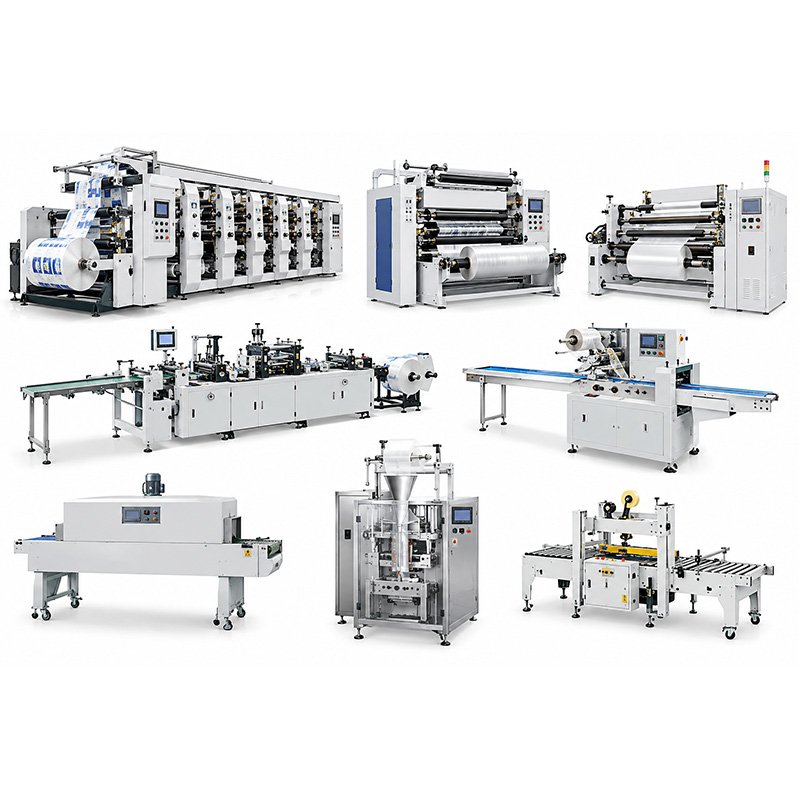
(Packaging bag making machine)
Most suppliers sell machines for one material family only. We cover all four, because our core business is packaging materials themselves: we know exactly which machine settings produce the board, film, cans and bottles that our own packaging customers buy every day. That lets us specify machinery by the output you need, not by the catalogue.
(Courier bag film blowing machine)
Two machines anchor this page — the fully automatic cartoning machine (which packs products into ready-made boxes) and the box forming machine (which manufactures the boxes in the first place). Below them you will find the complete equipment map for paper, plastic, metal and glass, so you can see where each machine fits in your production chain.

(Fully automatic injection molding machine)
Featured Machine 1: Fully Automatic Cartoning Machine
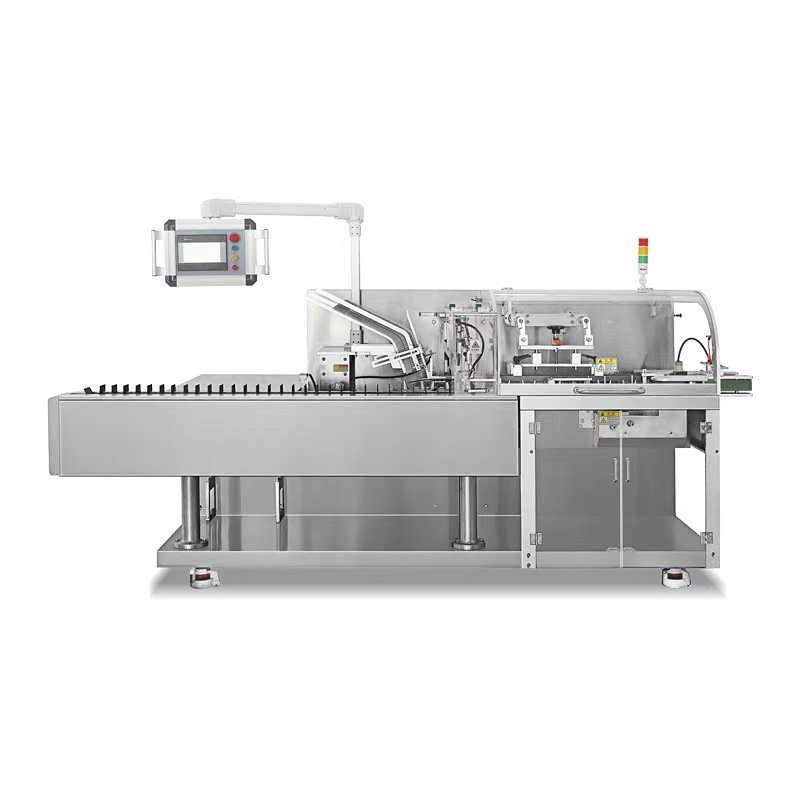
The cartoner is the last machine most products meet before the shelf. It takes flat folding cartons from the magazine, erects them, loads your product (with or without a leaflet), closes the tuck or glue flaps and discharges a shelf-ready box — at 30 to 120 cartons per minute, with one operator overseeing several machines.
Automatic cartoning pays for itself the moment your manual packing line becomes the bottleneck: a skilled hand packs roughly 6–10 cartons per minute; the machine does 30–120, with consistent flap closure that manual packing cannot match. It is the standard machine in pharmaceuticals, food, cosmetics, and consumer electronics.
Best for
- Blister packs, bottles, tubes, sachets, pouches and cosmetics cartoned at speed
- Food: tea boxes, confectionery, baked goods, frozen food cartons
- Pharma and supplements (with leaflet insertion and batch coding)
- Any brand moving from hand packing to machine-speed output
- Cantilevered HMI arm — touch screen swings out for access; recipe storage for fast size changes
- Open frame with guard cover — full visibility of erecting, loading and closing stations
- Box magazine conveyor (left) — flat cartons fed automatically, no pre-erecting by hand
- Stack light — instant run/fault status across the hall

Typical technical specifications
| Item | Specification (typical — final build quoted to your product) |
|---|---|
| Machine type | Horizontal intermittent / continuous motion cartoning machine |
| Output speed | 30–120 cartons/min by model and product feeding method |
| Carton size range | Typically (L)60–200 × (W)30–120 × (H)15–80 mm; wider ranges on request |
| Carton board | 250–350 gsm white board, kraft or micro-flute |
| Closing styles | Tuck-in flap, glue flap (hot-melt), lock bottom, or combined |
| Product feeding | Manual infeed up to full automatic feeder matched to your product |
| Options | Leaflet/brochure insertion, batch coder, embossing, vision checking |
| Control | PLC + touch screen HMI, recipe storage, fault diagnosis |
| Frame | Stainless steel 304 contact areas; anodised aluminium and steel structure |
| Power supply | AC 220V/380V, 50/60 Hz, approx. 3–5 kW by model |
| Air supply | 0.5–0.7 MPa clean dry compressed air (glue and vacuum circuits) |
| Changeover | Size parts for quick change; new size parts quoted per carton range |
| MOQ | 1 machine |
Featured Machine 2: Box Forming Machine
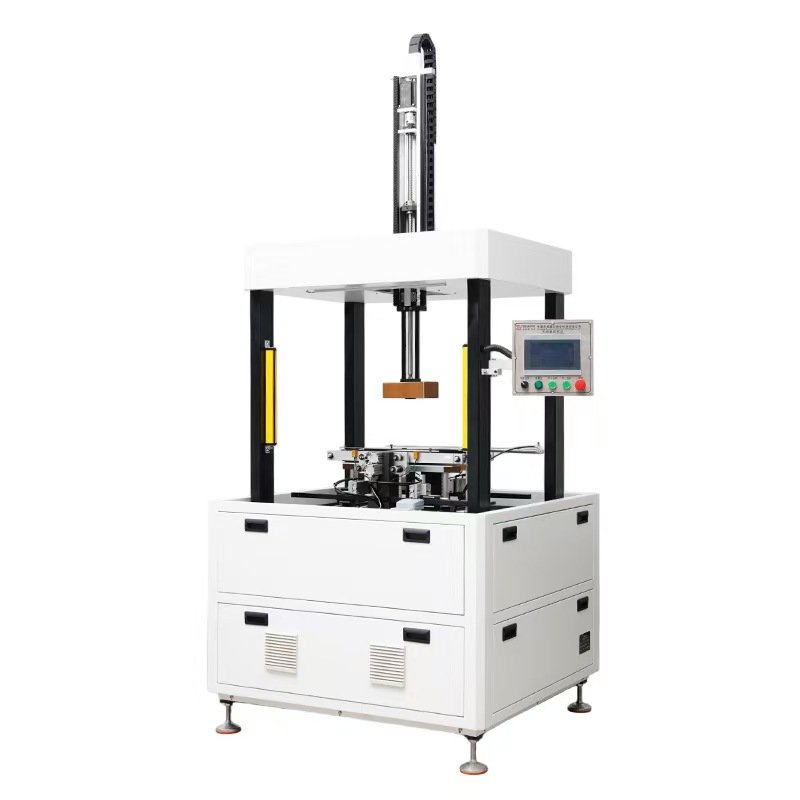
- Four-column press frame — even pressing force across the whole box surface
- Heated pressing head — activates adhesive for corner wrapping and flattens wrinkles
- Positioning jig on table — locates the chipboard shell and wrap paper precisely
- PLC panel with indicator lights — simple two-hand operation, low training cost
The box forming machine is where a box is born: it takes a pre-cut greyboard/chipboard shell and a die-cut sheet of decorative paper or printed wrap, positions them, folds the paper over the board edges, and presses the assembly under a heated head — producing a finished box with tight corners and a bubble-free surface.
This is the machine behind premium packaging: gift boxes, chocolate boxes, cosmetics sets, tea and wine boxes, phone packaging. Semi-automatic models form 15–25 boxes per minute with a two-hand station; fully automatic lines with feeding robots run far higher. For a brand launching premium packaging, a semi-automatic forming machine plus trained operators is the classic first step.
Best for
- Rigid gift boxes, luxury cosmetics and chocolate boxes
- Book-style and drawer boxes with wrap paper
- Packaging workshops adding box making to a printing business
- Brands bringing premium box production in-house
Typical technical specifications
| Item | Specification (typical — final build quoted to your box) |
|---|---|
| Machine type | Semi-automatic rigid box forming machine (heated press type) |
| Output speed | 15–25 boxes/min semi-automatic; higher on automatic feeding lines |
| Box size range | Typically (L)50–400 × (W)40–300 × (H)10–120 mm by model |
| Board | Greyboard / chipboard 1–3 mm; formed or folded corner types |
| Wrap paper | Printed art paper, specialty paper, kraft, fabric-backed paper |
| Forming method | Paper positioning → corner folding → hot-press wrapping (temperature adjustable) |
| Control | PLC with digital positioning, temperature and timer settings |
| Power supply | AC 220V, 50/60 Hz, approx. 2–4 kW incl. heating |
| Air supply | 0.5–0.7 MPa compressed air |
| MOQ | 1 machine |
Machinery for All Four Packaging Material Families
Whatever material you want to produce, the equipment chain below shows the standard route from raw material to finished packaging. Click through with your sales contact to quote any single machine or the complete line.
1. Paper packaging equipment — the most mature machine family
| Equipment | What it does | Key machines |
|---|---|---|
| Corrugated board production line | Converts kraft paper rolls into corrugated board — the core line behind every shipping box | Wet end: reel stands, automatic splicer, single facer (forms the flute), glue applicator, double facer. Dry end: rotary cutter, slitter-scorer |
| Box making equipment | Converts board sheets into finished boxes with print, slots and creases | Printer-slotter-die-cutter, folder-gluer, box forming machines (featured above) |
| Other paper products | Specific paper packaging formats | Paper cup machines, paper bowl machines, hand bag (carrier bag) making lines |
2. Plastic (flexible packaging) equipment — a continuous four-stage flow
| Stage | What it does | Key machines |
|---|---|---|
| Film making | Turns plastic pellets into film | Film blowing machines (mono or 3/5-layer co-extrusion for food and heavy-duty bags), cast film lines (PE, PP) |
| Printing | Prints the film web | Gravure presses (long runs, finest quality), flexo presses (shorter runs, fast changeover) |
| Laminating | Bonds multiple films for barrier and strength | Dry laminators, solventless laminators (the current industry standard for food), extrusion laminators |
| Slitting & bag making | Converts printed laminate into finished bags | Slitter-rewinders, bag making machines (bottom seal, side seal, vest carrier, stand-up pouch lines) |
3. Metal packaging equipment — precision, high automation
| Equipment | What it does | Key machines |
|---|---|---|
| Can stock production | Rolls aluminium to ultra-thin, strong can stock | Six-roll aluminium cold rolling mills |
| Can body lines | Forms cans from stock | Aluminium DWI lines (shell press, body maker, trimmer, washer, internal spray, necking/flanging); resistance-welded body lines for steel cans |
| Ends & easy-open lids | Produces and converts ends | End press lines and easy-open end conversion lines |
4. Glass container equipment — a high-temperature continuous process
| Stage | What it does | Key machines |
|---|---|---|
| Raw material handling | Weighs and mixes sand, soda ash and cullet precisely | Automatic batching systems and mixers |
| Melting & feeding | Melts the batch into glass; delivers gobs to forming | Electric furnaces / regenerative furnaces, feeders and forehearths |
| Forming | Forms gobs into bottles and jars — the heart of the plant | IS (individual section) machines, blow-and-blow for narrow-neck bottles, press-and-blow for jars and wide mouths |
| Annealing & inspection | Relieves internal stress, then verifies quality | Annealing lehrs, camera inspection machines, comprehensive testers |
Mapping Your Production Chain
A packaging factory is a chain of machines, and the chain is only as strong as its slowest station. Before quoting any single machine, we map where it sits:
Beyond production machinery we also supply the downstream end-of-line equipment: filling machines, liquid filling lines, sealing machines, overwrapping machines, multi-function packaging machines, labeling machines, cartoning and case packing machines, and strapping machines. One supplier, the whole chain — and the interface between stations engineered, not improvised.
How to Specify a Machine (5 Steps)
- Define the product or material. Send samples of what you produce or pack. Samples decide machine class faster than any description — a bag maker for bread bags is not a bag maker for 1 kg rice bags.
- Set the output target. State output per hour or per shift. We size the machine with realistic efficiency (85–90%), not nameplate maximum — this is why our quoted speeds are achievable on your floor.
- Fix the size range. Give the smallest and largest box, bag, can or bottle. Size range determines changeover parts, and often the whole machine model.
- Confirm your utilities. Power supply (voltage, phases, available load), compressed air, and workshop dimensions. The most common delivery delay across the industry is a factory discovering its power supply does not match the ordered machine.
- Ask for the line view. We check the new machine against your existing equipment — infeed heights, speeds and conveyor interfaces — so the station slots into your flow instead of becoming an island.
Our Machinery Services
| Service | What you get |
|---|---|
| Line design & layout | CAD layout with machine positions, material flow, operator stations and utility points — included with every quotation |
| Machine selection | Specification matched to your product samples and output target, across all four material families |
| Installation & commissioning | Remote video commissioning on every machine; on-site installation and supervision by our engineers for production lines |
| Operator training | 3–7 days training on operation, size changeover and daily maintenance — in English or with translated materials |
| Spare parts | Recommended starter package with first order; fast-moving spares stocked and shipped worldwide; internationally available PLC/servo brands for local servicing |
| After-sales | 12-month warranty, lifetime remote diagnosis by video call, upgrade consultations as your output grows |
| MOQ | 1 machine — from single workshops to turnkey plants |
Related equipment pages
Frequently Asked Questions
What is the minimum order quantity for packaging machines?
MOQ is 1 machine. We supply single machines for workshops adding one process, and complete turnkey lines for factories building new capacity. Machines are built to order after the technical specification is confirmed, and the price depends on machine type, output speed and automation level.
How do I choose between a box forming machine and a cartoning machine?
A box forming machine creates the box: it takes flat pre-cut chipboard and wrap paper and forms finished rigid or folding boxes, ready for hand or machine loading. A cartoning machine loads the product: it takes ready-made boxes and automatically erects, loads, folds and closes them around your product. If you make boxes, you need forming equipment; if you pack products into boxes, you need a cartoner. Many of our customers run both.
Which machine do I need to start producing plastic packaging bags?
The standard entry line is: a film blowing machine (three-layer co-extrusion covers most food and retail applications) plus a bag making machine matched to your bag style (bottom seal, side seal, vest carrier or T-shirt bag). Add a flexo or gravure printing press when you need printed bags. For laminated stand-up pouches you add a laminator and pouch making machine. Tell us your bag style and monthly volume and we will quote the complete chain.
Can you help design the production line and factory layout?
Yes. Line layout design is part of every quotation. Send your workshop dimensions, power supply and target output, and our engineers return a CAD layout showing machine positions, material flow, operator stations and utility connections. This prevents the most common regret in machinery buying: a line that runs well but does not fit the building.
Do you provide installation, commissioning and training?
Yes. Every machine ships with English manuals, wiring diagrams and remote video commissioning support. For production lines we offer on-site installation and supervision by our engineers, followed by 3 to 7 days of operator and maintenance training. Ask your sales contact which service level applies to your destination market.
What information do you need to quote a machine accurately?
Four things: (1) the product or material you are packaging or producing, with samples if available; (2) required output per hour or per shift; (3) the size range of boxes, bags, cans or bottles; (4) your factory power supply (voltage, phases, available load). With these we quote the right machine class the first time instead of quoting the biggest machine.
What is the delivery time and how is a machine shipped?
Standard machines ship in 30 to 60 days after specification confirmation and deposit; complete custom lines take 60 to 120 days. Machines are exported in seaworthy wooden cases with moisture barrier wrapping, and major components are fixed and labelled for reassembly. We prepare full export documentation including packing lists and, where applicable, CE conformity files.
What about spare parts, warranty and after-sales support?
Machines carry a 12-month warranty on the main structure and systems, with wear parts such as belts, seals and heating elements supplied as a recommended spare-parts package with the first order. We stock fast-moving spares and ship worldwide; PLC and servo components use internationally available brands so local electricians can service them. Remote diagnosis by video call is free for the life of the machine.
Can one supplier really cover paper, plastic, metal and glass machinery?
Yes — that is our model. JAJA Packing integrates more than 1,200 vetted partner factories, so we quote and deliver the right specialised machine for each material family, then take responsibility for the interface: one contract, one shipment plan, one commissioning team. You avoid coordinating four machinery vendors across four time zones, and the machines arrive matched to the packaging materials you will actually run.
