Product Overview
OPP is the film most people have held without knowing its name: the crisp, glass-clear wrap around toast loaves, the shiny twist wrapper on candies, the sleeve on greeting-card-and-chocolate gift sets. Two properties explain its dominance. Orientation — stretching the polymer in two directions — makes it stiff yet thin, so 20 μm of OPP wraps like 50 μm of ordinary plastic. And clarity — ≥90% light transmission with a gloss surface — makes the food, not the film, the thing you see.

Compliance is confirmed batch by batch: FDA 21 CFR and EU LFGB for food contact, REACH for EU shipments. Stock sheets and rolls ship from 1 carton; samples are available for machine trials before committing to volume.
Full Specifications
| Parameter | Specification |
|---|---|
| Product name | Food-Grade OPP Film (BOPP) — Sheets & Rolls |
| Material | Biaxially oriented polypropylene (BOPP/OPP) |
| Thickness range | 15 / 20 / 25 / 30 / 40 / 50 μm (custom gauges on request) |
| Transparency | ≥90% light transmission, high-gloss surface |
| Density | 0.91 g/cm³ (lightweight — more area per kg than PE or PET) |
| Tensile strength | MD ≥130 MPa · TD ≥250 MPa (orientation strengthens both axes) |
| Supply form 1 | Pre-cut sheets: 100 × 150 mm up to 600 × 800 mm, any custom size, packed in reams of 100–500 |
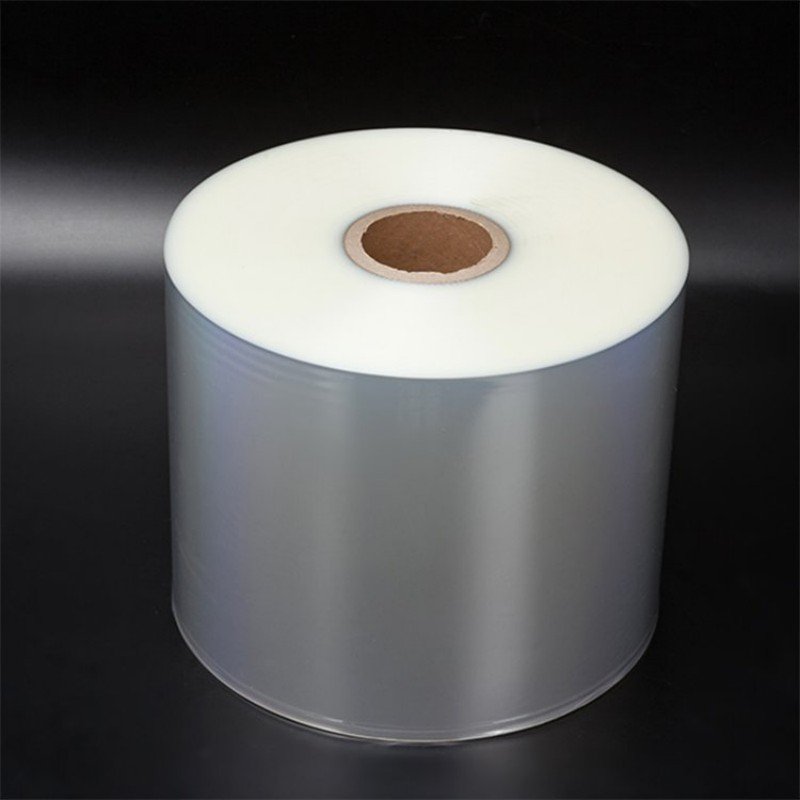
| Supply form 2 | Rolls: 50–1,600 mm web width, 76 mm (3″) core, 3,000–8,000 m jumbo / Slimjim widths for machines |
| Sealability | Plain (non-sealable, for twist/fold/tie) · single or double-side heat-sealable, seal range 100–140 °C |
| Corona treatment | 38–42 dyne/cm (print-ready), inside/outside treatment per spec |
| Printing | Gravure / flexo up to 8–10 colors, food-safe inks; plain stock available |
| Barrier (20 μm) | WVTR ≈4–6 g/m²/24h · OTR ≈1,500–2,500 cm³/m²/24h — moisture-focused barrier |
| Temperature range | Use -20 °C to +120 °C (chilled and ambient food service) |
| Food-contact compliance | FDA 21 CFR, EU LFGB — test reports available on request |
| Other certifications | REACH; supplier network holds ISO 9001, BSCI, ISO 45001 |
| Recyclability | PP recycling code 5; mono-material stream |
| Typical price range | US$0.005–0.20 per sheet/pc at volume; rolls quoted per kg |
| MOQ | Stock sizes from 1 carton · custom sheets from ~100 kg · printed film from ~200 kg |
| Lead time | Stock: 3–7 days · custom/printed: 10–15 days |
| Ports of loading | Shanghai / Ningbo, China |
How It Works: What “Oriented” Means & Why It Matters
1. Biaxial Orientation: The Whole Product in One Process Step
Polypropylene as extruded is a soft, hazy film. Biaxial orientation changes everything: the extruded sheet is reheated and stretched ~4.5–5× in the machine direction and ~8–10× in the transverse direction. This pulls the polymer chains into alignment in both axes — the “bi” in BOPP. The result is a film that is simultaneously thinner, stronger, clearer, glossier and stiffer than the same polymer unoriented. This is why 20 μm BOPP wraps a loaf crisply while 50 μm unoriented PP still sags.
2. Sheet vs. Roll: Same Film, Two Workflows
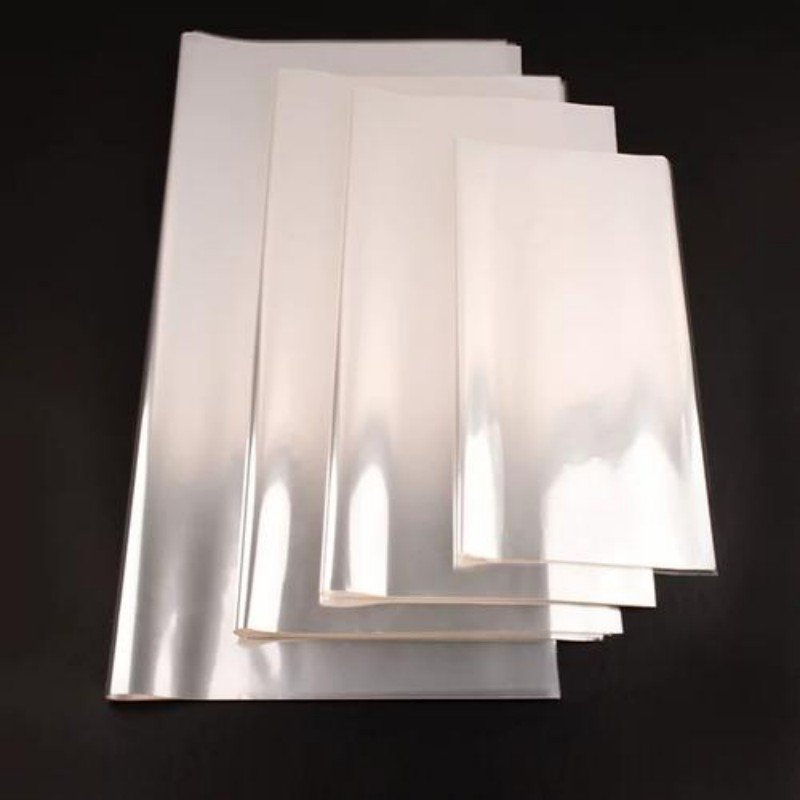
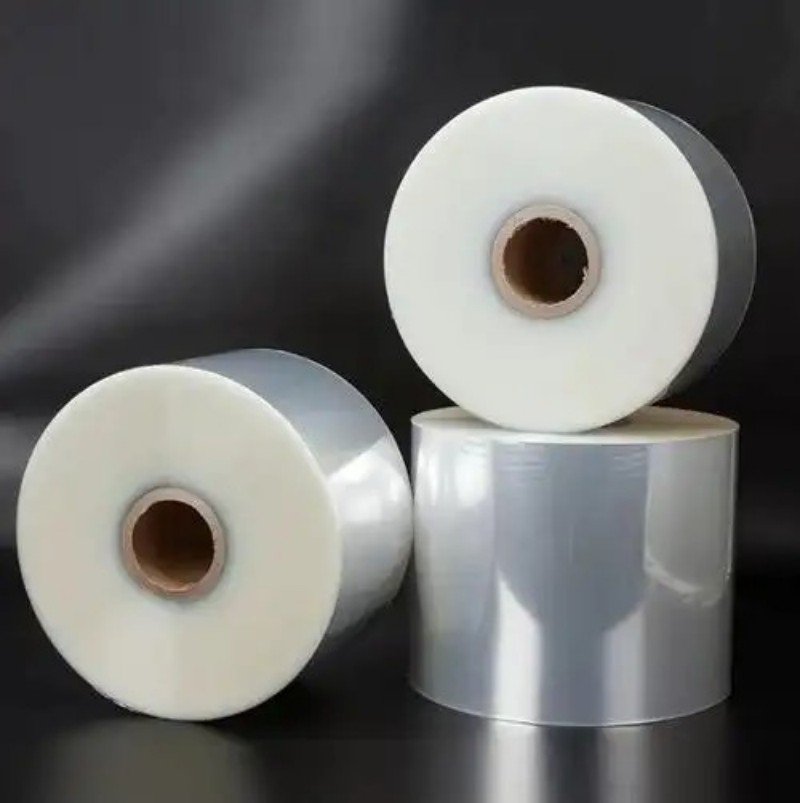
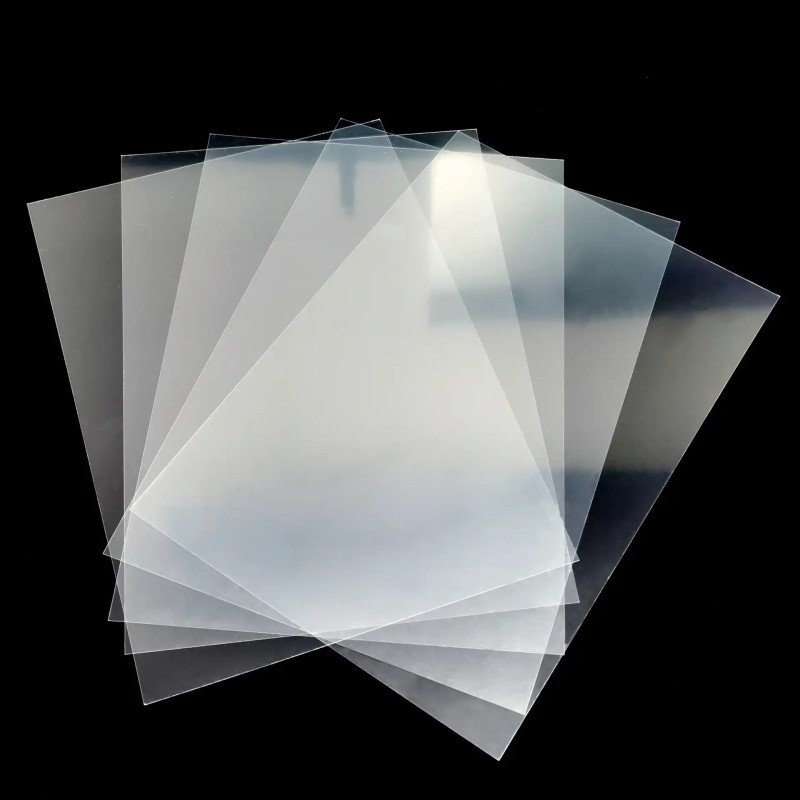
Sheets (first image) are pre-cut to size and packed in reams — the supply form for hand wrapping stations: candy twist wrap, sandwich and toast wrapping, interleaving between food layers, gift wrapping. No machine, no setup, consistent portion control: every wrapper is identical, so costing is exact. Rolls (second image) feed machines: L-sealers, flow-wrap (HFFS) machines, and converting lines that make bags and pouches. Rolls run 50–1,600 mm wide on standard 76 mm cores, so they drop onto existing equipment without adapters.
3. Sealable vs. Plain: Match the Film to the Closure
Plain OPP cannot be heat-sealed — it is designed for closures that grip mechanically: twist, fold, tie. Heat-sealable OPP carries coextruded sealant layers and bonds to itself at 100–140 °C on impulse sealers, band sealers, L-sealers and flow-wrap machines. Specifying the wrong version is the most common film ordering error: sealable film on a twist-wrap line wastes the sealant layer; plain film on a machine line fails to seal. Send us your machine and product, and we spec the film correctly.
4. The Moisture-Focused Barrier
OPP’s orientated structure gives it a genuinely useful water-vapor barrier (WVTR ≈4–6 g/m²/24h at 20 μm) — that is what keeps crackers crisp and bread from drying. Its oxygen barrier is modest, which is a feature for some products: candy and bread need aroma transfer, not total sealing. Where oxygen control matters, OPP is metallized or laminated — available on request.

Key Features Explained
Crystal Clarity — ≥90% Transmission
Biaxial orientation eliminates the haze of ordinary polypropylene. The result is a film that disappears around the product: sugar dusting, crust color, candy shell gloss all show true. For retail, this is the difference between “wrapped” and “presented” — and it is why OPP owns the candy and bakery wrapper market.
Stiffness Without Weight
At 0.91 g/cm³ — the lowest density of any common packaging plastic — OPP delivers more wrapped area per kilogram than PE (0.92), PET (1.38) or PVC (1.4). Combined with orientation-driven stiffness, a 20 μm OPP sheet handles like a much heavier film. Buying by weight therefore buys more packaging: film economics in their purest form.
Two Supply Forms, One Quality Standard
Sheets for stations and stores; rolls for machines and converters. Both come from the same qualified film lines with the same compliance documents, so a brand can wrap counter products by hand and retail volumes by machine without re-approving a second supplier.
Print-Ready Surface
Corona treatment at 38–42 dyne/cm makes the film accept gravure and flexo ink directly — up to 8–10 colors with food-safe inks. This is the film behind most printed snack and candy wrappers. Order printed film from us, or plain treated film for your own printing plant (confirm treatment side when ordering).
Recyclable Mono-Material
PP recycling code 5, single polymer, no laminates required for most applications — one of the cleaner recyclability stories in flexible packaging, and a genuinely lower-CO2 option per functional unit than most alternatives.
Thickness Selection Guide
Match gauge to application — thicker is not automatically better:
| Thickness | Typical Applications | Why |
|---|---|---|
| 15 μm | Candy twist wrap, inner liners, print lamination | Softest gauge, folds and twists without spring-back |
| 20 μm | Bakery sheets, sandwich wrap, flower wrap, general wrapping | The workhorse gauge — best stiffness/clarity/cost balance |
| 25 μm | Converted bags, toast loaf wrap, heavier candy | Extra body for bag conversion and retail handling |
| 30 μm | Snack pouches, machine flow-wrap for heavy products | Puncture margin on hard-edged products |
| 40–50 μm | Heavy-duty wrap, lamination base, mechanical loading | Maximum durability; still lighter than equivalent PE |

Applications & Suitable Products
Typical Applications
| Application | Recommended Spec | Form |
|---|---|---|
| Candy & chocolate twist wrap | 15 μm plain, printed | Sheets / narrow rolls |
| Bakery & toast wrapping | 20 μm heat-sealable or plain | Sheets / 300–500 mm rolls |
| Sandwich & deli wrap | 20 μm, plain or printed band | Sheets |
| Flow-wrap machine film (HFFS) | 20–30 μm heat-sealable, Slimjim roll | Rolls |
| Interleaving (food separation) | 15–20 μm plain | Sheets |
| Gift wrapping & baskets | 20–30 μm plain, large sheets | Sheets |
| Converter feedstock (bag making) | 25–40 μm, corona treated | Rolls |
Suitable Products
| Category | Examples | Fit Rating |
|---|---|---|
| Bakery | Toast, buns, sandwiches, pastries | Excellent |
| Confectionery | Candy, chocolates, lollipops | Excellent |
| Snacks | Crackers, biscuits, dried fruit packs | Excellent |
| Non-food retail | Flowers, gift sets, stationery, textiles | Very good |
| Chilled & frozen | -20 °C service compatible | Good (verify seal at low temp) |
| High-oil, long-shelf-life foods | Fried snacks needing 6+ months life | Needs metallized/laminated version |
OPP Film vs. PE Film (Cling Wrap)
The two transparent food films are often confused — they solve different problems:
| Dimension | OPP Film (this product) | PE Film (cling wrap) |
|---|---|---|
| Clarity & gloss | ≥90% transmission, glass-like | Good but hazy |
| Stiffness / fold holding | Crisp, holds folds and twists | Soft, drapes, springs back |
| Density (area per kg) | 0.91 g/cm³ — most area per kg | 0.92 g/cm³ |
| Moisture barrier (WVTR) | ≈4–6 g/m²/24h @20 μm | Higher transmission |
| Printability | Excellent with corona treatment | Poor without treatment |
| Cling / stretch | None — mechanical closure required | Self-clinging, stretchable |
| Heat-seal temperature | 100–140 °C (sealable versions) | 90–120 °C, easier on basic machines |
| Typical cost per wrapped area | Lowest for stiff clear wrap | Higher per area at equivalent performance |
| Recyclability | PP code 5 stream | PE code 4 stream |
| Best for | Retail wrap, twist candy, machine flow-wrap | Cling, covering, stretch sealing |
How to Use & Convert the Film
- Define the closure method first — twist/tie needs plain film; heat-sealing machines need the sealable version.
- Match gauge to product using the thickness guide: 15 μm candy, 20 μm bakery, 25–40 μm bags and heavy wrap.
- For hand wrapping with sheets: center the product on the sheet, bring two edges together above it, and pull taut before twisting — tension is what makes a candy twist or bakery crown hold.
- For candy twist wrap: twist both ends in opposite directions 2–3 full turns; 15 μm film grips its own crease and stays closed without a tie.
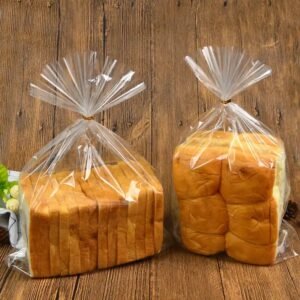
- For toast/bakery crown wrap: gather the sheet around the loaf, fan the excess into pleats, and close with a tie or sticker (mirrors the cinch-top bag technique).
- For heat-sealing: set the machine to 100–140 °C depending on the sealant layer; run a test seal and peel it — a good seal delaminates the film before the seal line separates.
- For machine rolls: confirm your machine’s web width and core size (76 mm standard) before ordering; Slimjim widths are cut to your spec.
- For printing: confirm corona treatment side (inside/outside) with your printing plant; 38–42 dyne/cm is the standard print-ready level.
- Store rolls vertically on end racks and sheets flat in their reams, away from sunlight and below 30 °C.
- Condition cold-stored film at room temperature for 2–4 hours before running — condensation on cold film ruins seals and print.
- Run a machine trial with sample rolls before volume ordering — we supply trial quantities for exactly this purpose.
- Verify compliance documents (FDA/LFGB) for the batch on arrival; we supply them with every food-contact order.

Frequently Asked Questions
What is food-grade OPP film?
OPP film is biaxially oriented polypropylene (also written BOPP): polypropylene film stretched in both machine and transverse directions, which aligns the polymer chains and gives the film its characteristic clarity, stiffness and strength. Food-grade means the film is produced under food-contact conditions with FDA 21 CFR and EU LFGB test reports available. It is one of the most common food packaging films worldwide — used in bread bags, snack wrappers, candy twist wrap and label faces.
What is the difference between OPP film and PE film (cling wrap)?
OPP is oriented: it is much stiffer, clearer and glossier than PE, holds a crisp fold, and prints beautifully — which is why it dominates retail food packaging. PE (as in cling wrap) is soft, stretchy and self-clinging but hazy and hard to print. OPP also seals at 100–140 °C on fast machines, while PE seals at lower temperatures. Rule of thumb: if the wrap needs to look premium and hold its shape, choose OPP; if it needs to cling and stretch, choose PE.
What thickness should I choose?
15–20 μm for candy twist wrap and lightweight inner liners; 20–25 μm for bakery sheets and general wrapping (the most popular range); 25–40 μm for pouches and bags converted from the film; 40–50 μm for heavy-duty wrap, lamination and mechanical loading. Thicker is not automatically better — 20 μm OPP outperforms 50 μm PE in stiffness and clarity while using less material.
Is the film heat-sealable?
Both options exist. Plain (non-sealable) OPP is used where the film is folded, twisted or tied — candy wrap, gift wrap, tie closures. Heat-sealable OPP has sealable layers coextruded on one or both sides and seals at 100–140 °C on band sealers, L-sealers and flow-wrap machines. Tell us your machine and product when requesting a quote and we will supply the matching version with the correct seal initiation temperature.
What forms does the film come in?
Three supply forms: pre-cut sheets (as shown — hand wrap, interleaving, candy wrap, gift wrap), jumbo and Slimjim rolls (for L-sealers, flow-wrap machines and converters), and converted bags or pouches made from the film. Sheets come in standard sizes from 100 × 150 mm to 600 × 800 mm with any custom dimension; rolls run 50–1,600 mm web width on 76 mm (3-inch) cores.
Can the film be printed?
Yes — OPP is one of the best printing films in the industry. Corona treatment (typically 38–42 dyne/cm) enables gravure and flexo printing up to 8–10 colors, which is why most snack and candy wrappers are OPP. We supply plain film for your own converters, or printed film with your design. For print-ready film, confirm the treatment side (inside/outside) with your printing plant before ordering.
Is OPP film recyclable?
Yes. Polypropylene is recyclability code 5 (PP) and mono-material OPP film is accepted in polypropylene recycling streams. It is also one of the lower-carbon packaging films: polypropylene uses less material than PE or PVC for the same stiffness, and OPP production generates less CO2 per functional unit than most flexible packaging alternatives. Avoid laminating OPP with other plastics if recyclability is a priority.
What is the MOQ and lead time?
Stock sizes of plain sheets and rolls are available from 1 carton; custom sheet sizes typically start around 100 kg per order and printed film around 200 kg. Lead time is 3–7 days for stock items and 10–15 days for custom or printed orders. Samples are available for machine trials before committing — contact WhatsApp +86 131 2388 3167 or sales1@jajapacking.com for a quote within 24 hours.
OEM & Our Services
JAJA Packing is a professional OEM & ODM packaging service provider — a packaging supply chain integrator and exporter with a network of over 1,200 partner factories, 20+ product categories and 20,000+ packaging designs. We manage the entire process: supplier screening, price comparison, prototyping, quality control, delivery scheduling and final export.
| Service Item | Details |
|---|---|
| Customization scope | Thickness (15–50 μm), sheet size, roll width/core, plain vs. heat-sealable, corona treatment side, print up to 8–10 colors |
| Design support | Free artwork and spec consulting; sample rolls and sheets for machine trials |
| MOQ | Low MOQs — stock from 1 carton; custom from ~100 kg; printed from ~200 kg |
| Quote speed | Quote within 24 hours of receiving specifications |
| Compliance support | FDA, LFGB, REACH, RoHS, CE, ISO certificates and test reports assisted |
| Factory audits | On-site factory inspections and virtual audits welcome |
| After-sales | Any questions or claims answered within 24 hours |
| Payment & shipping | Flexible terms; loading from Shanghai or Ningbo ports; worldwide export |
Related Products
The film, and what we convert it into:
- Food-Grade Clear Bread Bag (Cinch-Top) — bread bags converted from this same film, with tie closure kit.
- Food-Grade PET Bread Bag with Handle — the premium converted version with header and handle.
- Food-Grade Kraft Stand-Up Pouch with Window & Zip Lock — film windows and liners for paper pouches.
- Food-Grade Plastic Packaging — all food-contact plastic packaging categories.