

Product Overview
What these bottles are, who they’re for, and the honest math behind the 5,000-pc MOQ.
A glass bottle is the packaging choice buyers make when the bottle itself is part of the product — spirits, wine, cold-pressed juice, olive oil, premium sauces. Glass is chemically inert (nothing migrates, no flavor scalping over years on the shelf), gives a perfect gas and aroma barrier, carries a premium perceived value, and is infinitely recyclable.

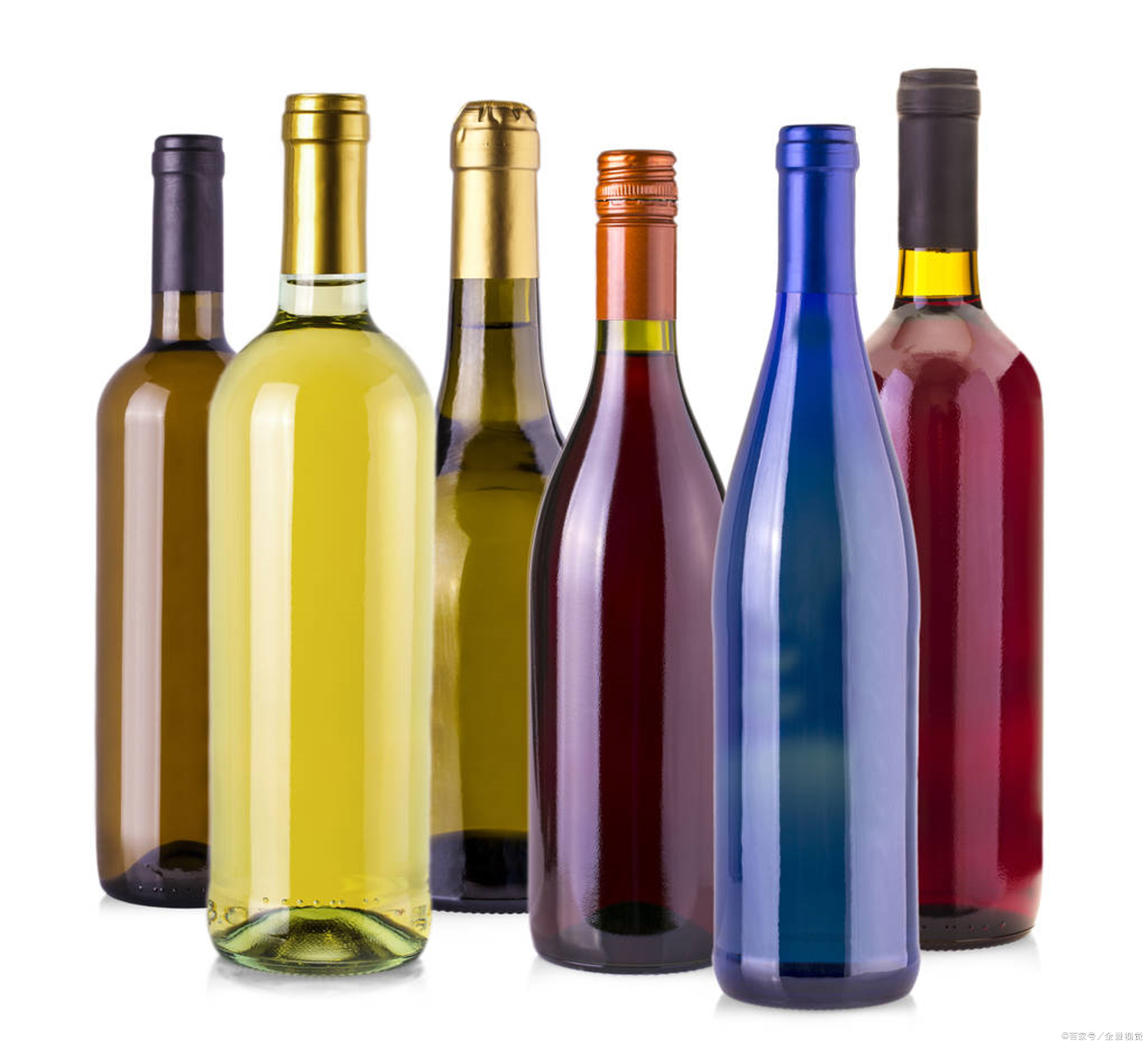
Our range covers 200 ml to 1,000 ml in clear flint plus furnace-colored amber, emerald green and — on dedicated batches — cobalt blue and ruby red like the colored bottles above. Decoration runs from permanent mold embossing (visible on the flint bottles in the first photo) to dishwasher-safe ceramic printing, etching, and labels.


Route A — Stock mold, 5,000 pcs up
Hundreds of proven molds (long-neck spirits, Bordeaux, Burgundy, round, square, milk style) in flint, amber and green. Fastest lead time, lowest cost, artwork can change every order.
Route B — Custom shape & color, 30,000+ pcs
Your own silhouette, embossed logo in the mold, custom weight and finish. We build the 3D model, tool the mold, and run two sample rounds. The mold is yours and stored free for repeat orders.
Color: In the Glass, Not On It
The single most misunderstood thing about colored glass — and the reason the bottles above look the way they do.
Glass color is created in the furnace by adding metal oxides to the molten batch: cobalt for blue, chromium and iron for green, selenium and sulfur for amber and red. The color is the material itself — it cannot chip, fade, scratch off, or flake in the dishwasher, because there is no layer to fail.
| Color | How it’s made | Typical use | MOQ |
|---|---|---|---|
| Flint (clear) | No colorant — pure batch | Spirits, oil, juice — shows the liquid | 5,000 pcs |
| Amber (dark brown) | Iron, sulfur & carbon compounds | Beer, kombucha, syrups — best UV protection | 5,000 pcs |
| Emerald / dark green | Chromium + iron oxides | Wine, olive oil, spirits | 5,000 pcs |
| Cobalt blue | Cobalt oxide | Water, gin, cosmetics, honey | 20,000–50,000 pcs |
| Ruby red | Selenium + heat treatment | Limited editions, liqueurs | 20,000–50,000 pcs |
| Opal / milk white | Fluorides / bone ash | Lotions, premium dairy | 20,000–50,000 pcs |
Functional bonus: amber and dark green filter UV light that degrades beer, kombucha, oils and vitamins — color choice is preservation, not just branding.
Technical Specifications
The numbers buyers actually ask about before ordering.
| Specification | Detail |
|---|---|
| Material | Soda-lime glass, food-contact compliant (FDA, EU 1935/2004); high-flint option for maximum clarity |
| Capacity range | 200 ml / 375 ml / 500 ml / 700 ml / 750 ml / 1,000 ml (custom weights & volumes from 30,000 pcs) |
| Colors (stock) | Flint, amber, emerald green, dark green — furnace colors |
| Colors (batch) | Cobalt blue, ruby red, opal white, custom Pantone-approximate glass tones |
| Neck finishes | ROPP 28 mm (spirits screw), crown 26 mm (beer/carbonated), cork finish with or without bartop, Grolsch-type swing top (select molds) |
| Decoration | Mold embossing, ACL ceramic screen printing (1–4 colors), acid etch/frost, labels, shrink sleeves |
| Weight | Standard weight (industry typical); lightweight option from 30,000 pcs; heavy-base “premium feel” option on select molds |
| Compliance documents | Food-contact certificates per shipment; recycled cullet content documentation on request |
| Packaging | Partitioned export cartons / trays, palletized 1,200×1,000 mm, shrink-wrapped, drop-tested |
| MOQ | 5,000 pcs per SKU (stock mold + stock color); 20,000–50,000 pcs for batch colors; 30,000–50,000 pcs for custom molds |
| Lead time | 15–25 days stock molds; 35–50 days new mold (two sample rounds included) |
| Sampling | Empty bottle samples in 5–7 days (stock); printed/label samples before production run |
Bottle Shapes & Sizes
Stock silhouettes cover most brands — and the finish is decided by the mold, so choose it early.
Long-neck spirits
The bottle in the center of our flint photo. 700–750 ml, tall and slim, emboss-friendly shoulders. Whisky, gin, vodka, rum.
Bordeaux straight-wall
Classic wine and cider silhouette, 375–750 ml, stacks efficiently on shelves and in cases.
Burgundy sloped
Softer shoulders, wider body. Wine, cold-pressed juice, kombucha.
Bartop cork finish
The short bottle on the right of the flint photo — flat wax-seal-style top for cork or wax-dipped presentation. Premium oils and spirits.
Round / decanter style
Wide-shoulder display bottle for syrups, oils and gift spirits.
Milk / juice style
Short wide-mouth bottle (seen in the colored set) with 38 mm or 48 mm finish. Dairy, juices, sauces, yogurt drinks.
How to choose your size
- Decide the fill volume legally required — spirits categories fix the bottle size (700/750 ml); food products have more freedom.
- Match the closure to the category before the shape: spirits → ROPP 28 mm; wine/still premium → cork or bartop; carbonated → crown 26 mm.
- Check your filler’s bottle plate and star wheels — send us the machine’s bottle-drawing; we match the body diameter, height and neck.
- Consider shelf height at retail — a 330 mm bottle fits standard spirit shelves; taller bottles get shelf-edge display problems.
- Order a physical sample first — weight in hand is a purchase driver; the same 700 ml can feel cheap or premium depending on glass distribution.
Neck Finishes & Closures
The finish (machined top of the neck) and closure must be chosen together — this is the most common technical mistake in glass bottle ordering.
| Finish | Closure | Best for | Notes |
|---|---|---|---|
| ROPP 28 mm | Aluminum pilfer-proof screw cap | Spirits, oils, syrups | Tamper-evident band breaks on first open; most exported spirits format |
| Crown 26 mm | Crown cork | Beer, carbonated drinks, kombucha | Requires crowning machine; highest pressure tolerance |
| Cork finish | Natural/synthetic cork | Wine, aged spirits | Needs correct cork bore tolerance; consider TCA-free corks |
| Bartop / wax-seal | Cork + wax dip or t-bar | Premium & gift spirits | The flat “sealed” look; pairs with embossed bottles |
| Screw 38/48 mm (wide) | Plastic or metal wide cap | Juice, dairy, sauces | Hot-fill capable; pairs with induction liner for shelf life |
| Swing top (select molds) | Grolsch-type ceramic stopper | Craft beer, kombucha | Reusable closure = marketing asset; check headspace for carbonation |
Logo & Decoration Options
Four permanent routes and two flexible ones — chosen by volume, color count and wash requirements.
| Option | How it works | Best for | Watch out |
|---|---|---|---|
| Mold embossing | Logo formed as raised/recessed glass in the mold itself | Spirits & premium brands; visible on our flint bottles | Requires custom mold (30,000+ pcs); zero ink, never wears off |
| ACL ceramic print | Glass-frit ink screen printed, fired at 550–600 °C into the surface | 1–4 color logos that survive dishwashers and years of handling | Colors on glass differ from Pantone on paper — we fire a physical color sample first |
| Acid etch / frost | Controlled surface frosting, masked to your artwork | Luxury look, tactile contrast zones | Adds cost per piece; usually combined with one ceramic color |
| Electroplated / lacquered accents | Metallic or colored coating on select areas | Limited editions, black/matte spirits bottles | Coating (not furnace color) — best on protected areas |
| Pressure-sensitive labels | Self-adhesive labels, any full-color artwork | Small batches, frequent design changes, regulatory text | Choose film labels for chilled/wet environments |
| Shrink sleeves | 360° printed sleeve, shrunk in tunnel | Full-wrap graphics, colored-liquid products | Covers the glass — loses the “premium glass” visual; still recyclable with proper sleeve specs |
Design rule of thumb: embossing + one ceramic color is the classic spirits formula — permanent, tactile and cheaper than multi-color printing. Save full sleeves for when you need photographic artwork.
How Glass Bottles Are Made
Seven steps from sand to pallet — knowing them helps you ask the right questions of any supplier.
- Batch mixing — sand, soda ash, limestone and ~25% recycled cullet melted at ~1,550 °C; metal oxides added here for furnace colors.
- Gob forming — molten glass cut into precise-weight gobs (this weight defines your bottle’s final weight).
- IS machine forming — press-blow for wide-mouth, blow-blow for narrow-neck bottles; the mold sets shape, embossing and finish in one pass.
- Annealing (lehr) — bottles reheated to ~550 °C and cooled over ~1 hour to remove internal stress. This is the step that decides whether hot-filling survives — poorly annealed glass cracks on the filler. It’s the first thing we check when auditing a glassworks.
- Coating & inspection — hot-end/cold-end coatings for scratch resistance; automatic cameras reject dimensional and visual defects; we add manual inspection on finish surfaces.
- Decoration — ACL printing or etching fired after forming; labels and sleeves applied by you or by us.
- Packing — partitioned cartons on pallets, drop-tested, desiccant for sea freight.
Filling & Handling Rules
Five rules that prevent almost every “my bottles cracked / leaked” complaint.
1. Respect thermal shock limits
Standard soda-lime tolerates ~40 °C sudden difference. Fill hot sauce at 85 °C into warm bottles, never into cold ones off a truck in winter.
2. Rinse before filling
Transport dust and cardboard fibers settle inside. A bottle rinser (air or water) costs minutes and prevents most “foreign matter” complaints.
3. Match the finish to your capper
ROPP caps need the right thread profile; crowns need correct crimping pressure. We supply line-trial samples before production.
4. Check torque, don’t guess it
Over-torquing ROPP caps cracks finishes; under-torquing leaks. Target 12–18 in-lbs for 28 mm; verify with a torque meter on the first pallet.
5. Store empty bottles covered
Open-air storage lets dust and insects into the bore — the classic cause of mystery contamination after filling.
Bonus: headspace & oxygen
For sensitive fills (juice, oil), target 1–2% headspace and consider nitrogen dosing — the closure matters as much as the glass for shelf life.

Applications
Where these bottles earn their keep — and where we’d steer you elsewhere.
| Product | Recommended bottle | Why |
|---|---|---|
| Whisky / gin / vodka / rum | Long-neck 700–750 ml, ROPP or bartop, embossed | Premium silhouette; embossing is the shelf differentiator |
| Wine & cider | Bordeaux / Burgundy 750 ml, cork finish | Category-standard shapes buyers recognize instantly |
| Beer / kombucha | 330–500 ml, crown 26 mm, amber or green | UV protection + pressure tolerance |
| Cold-pressed juice | 250–375 ml flint or green, wide screw finish | Glass protects flavor and vitamins; premium retail look |
| Olive oil & vinegar | 250–500 ml dark green marasca-style, ROPP | Dark glass prevents photo-oxidation of oil |
| Hot sauces & syrups | 150–375 ml flint, ROPP with liner | Acidic content — glass is inert, nothing migrates |
| Honey & preserves | See our glass jars | Wide-mouth jars fill and spoon better than bottles |
| Effervescent RTD drinks | Aluminum cans often win on weight & logistics — see our cans | Lighter freight, unbreakable, fast carbonation lock |
Glass Bottles vs PET Bottles vs Aluminum Cans
The three premium liquid formats, compared honestly — they compete less than you’d think.
| Dimension | Glass bottle (this product) | PET bottle | Aluminum can |
|---|---|---|---|
| Perceived value | Highest — weight, sound, clarity | Medium | Medium-high, trending up |
| Flavor & aroma integrity | Perfect — inert, zero scalping | Slight oxygen ingress over time | Excellent with liner |
| UV protection | Furnace colors (amber/green) | Clear PET degrades contents; needs UV masterbatch | Total — opaque |
| Shipping weight & freight | Heaviest — 8–10× a can | Very light | Lightest |
| Breakage risk | Real — pack & handle correctly | None | None |
| Hot filling | Up to ~85 °C with handling care | Only crystalline heat-set grades | No (standard cans) |
| Decoration | Embossing — permanent, tactile | Print & sleeves | Direct 8-color print at volume |
| Minimum order reality | 5,000 pcs (stock mold) | 1 pc (stock molds) | 2,000 pcs (stock tooling) |
| Recyclability story | Infinite, back-to-bottle | Recyclable, downgrades | Infinite, ~60-day loop |
| Best role | Premium / flagship / gift SKUs | Volume & e-commerce lines | Sparkling, outdoor, craft-to-scale |
OEM & Our Services
What you get beyond the bottle itself.
| Service | What it means in practice |
|---|---|
| Custom shape development | 3D modeling → mold making → two sample rounds → mass production; the mold is yours and stored free for repeat orders |
| Furnace color matching | Custom glass tones on dedicated batches (20,000+ pcs); free Pantone-approximate glass swatches before you commit |
| Decoration under one roof | ACL ceramic printing, etching, labeling and sleeving applied in-house — one PO, one QC standard |
| Closure sourcing | Matched ROPP, crown, cork and swing-top closures sourced and shipped with the bottles |
| Line-trial support | Sample packs matched to your filler and capper before mass production |
| Compliance documents | Food-contact certificates (FDA, EU 1935/2004) per shipment; recycled-content documentation on request |
| Export logistics | Palletized, drop-tested export packing; mixed-SKU consolidation with your other JAJA packaging |
JAJA Packing is a packaging supply-chain integrator based in Huzhou, China, working with 1,200+ audited factories — including specialist glassworks for spirits, food and beverage bottles. That means one team handles your glass bottles alongside jars, cans, closures and cartons, with consistent quality standards and consolidated shipping. Learn more about us, or browse related products: glass jars, aluminum cans, tin boxes.
Frequently Asked Questions
What is the MOQ for custom glass bottles, and why is it higher than other packaging?
Our MOQ is 5,000 pcs per SKU. Glass bottles are formed on an IS machine that runs one mold continuously, so changeovers and color batches carry real furnace cost. 5,000 pcs is the entry point for stock molds and stock colors (flint, amber, green). A fully custom bottle shape requires new tooling, which becomes economical at roughly 30,000–50,000 pcs.
Can you make bottles in any color?
Glass color lives in the furnace, not in a coating — blue comes from cobalt oxide, green from chromium/iron, red and amber from selenium/sulfur compounds. Flint (clear), amber and dark green are stock colors available from 5,000 pcs. Colors like cobalt blue, ruby red or opal white require a dedicated furnace batch and are quoted at 20,000–50,000 pcs. Never settle for spray-painted glass: it chips, scratches and fails dishwasher tests.
How do you print or emboss a logo on glass bottles?
Four main options: (1) ACL ceramic ink screen printing — fired onto the glass at 550–600 °C, dishwasher-safe and permanent; (2) embossing — the logo is formed in the mold itself, permanent and free of ink, but requires a custom mold; (3) acid etching / frosting for a premium matte look; (4) pressure-sensitive labels or shrink sleeves for full-color artwork and small batches. We advise on the right route based on your volume, color count and wash requirements.
Which closure fits my bottle — cork, ROPP or crown cap?
It depends on the finish (the machined top of the neck). Spirits typically use a 28 mm ROPP screw finish with a pilfer-proof cap; wine uses a cork finish (often with a bartop); beer and carbonated drinks use a 26 mm crown finish. The finish is decided by the mold, so confirm your closure supplier and filling line before we tool the bottle. We provide matched closure samples and can arrange a line trial.
Are the bottles food-grade and suitable for hot filling?
Yes. Our soda-lime bottles are made from food-contact-compliant glass meeting FDA and EU 1935/2004 requirements, with certificates available per shipment. Glass is inert — no migration, no flavor scalping. For hot-filled products (sauces, juices), we recommend filling at up to 85 °C with proper hot-bottle handling, or a heavier-wall flint bottle for extra thermal shock resistance.
What are the lead times?
Stock molds in stock colors: 15–25 days after artwork and deposit confirmation. New custom bottle shape (new mold): 35–50 days including 3D modeling, mold making, and two sample rounds before mass production. Sea freight for heavy glass is planned into every quotation.
Can I get a pre-production sample before committing to 5,000 pcs?
Yes. For stock molds we ship empty bottle samples within 5–7 days so you can check finish, weight and closure fit. For custom shapes, first samples come from the new mold after 3D drawing approval. Printed decoration samples (ACL or label) are provided before the production run.
How is glass packaged for export so it arrives intact?
Bottles are packed in partitioned cartons or trays on 1,200×1,000 mm pallets, shrink-wrapped with corner protection, with desiccant for sea freight. We run drop tests on the export pack and can match your 3PL’s carton limits. Typical breakage in transit is below 0.5%.
Is glass packaging recyclable?
Infinitely — glass is one of the few materials that recycles back into the same application without quality loss, and recycled cullet reduces furnace energy. We can supply recycled-content documentation where required. This is a genuine marketing asset for spirits, juice and premium food brands.
