

Product Description
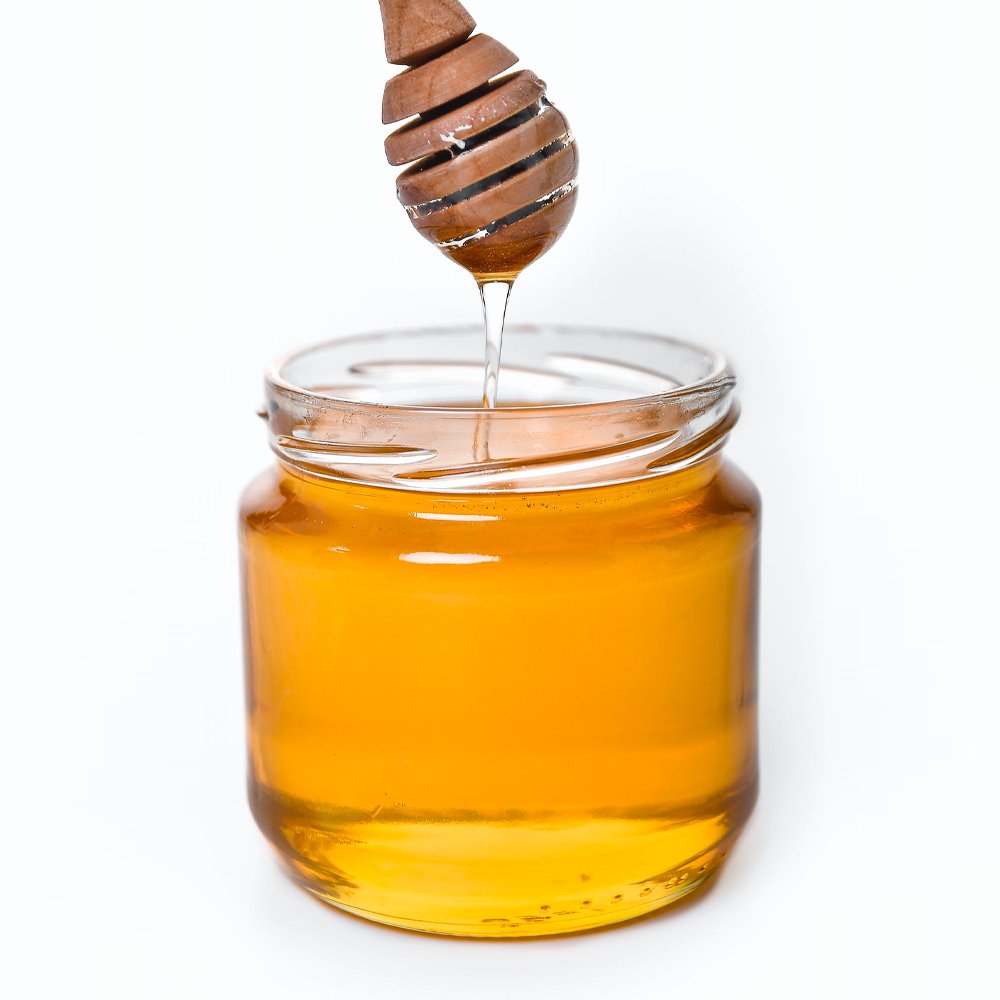
This is a food-contact glass jar — the packaging category of choice for honey, jam, preserves, pickles and anything premium that benefits from being seen and trusted. Glass is chemically inert: nothing migrates from the jar into the food, and nothing from the food soaks into the jar. It hot-fills safely, pasteurises without deforming, presents the product with a weight and clarity no plastic matches, and recycles infinitely without loss of quality. The jar pictured is our classic wide-mouth honey jar, one of hundreds of stock shapes we produce from.

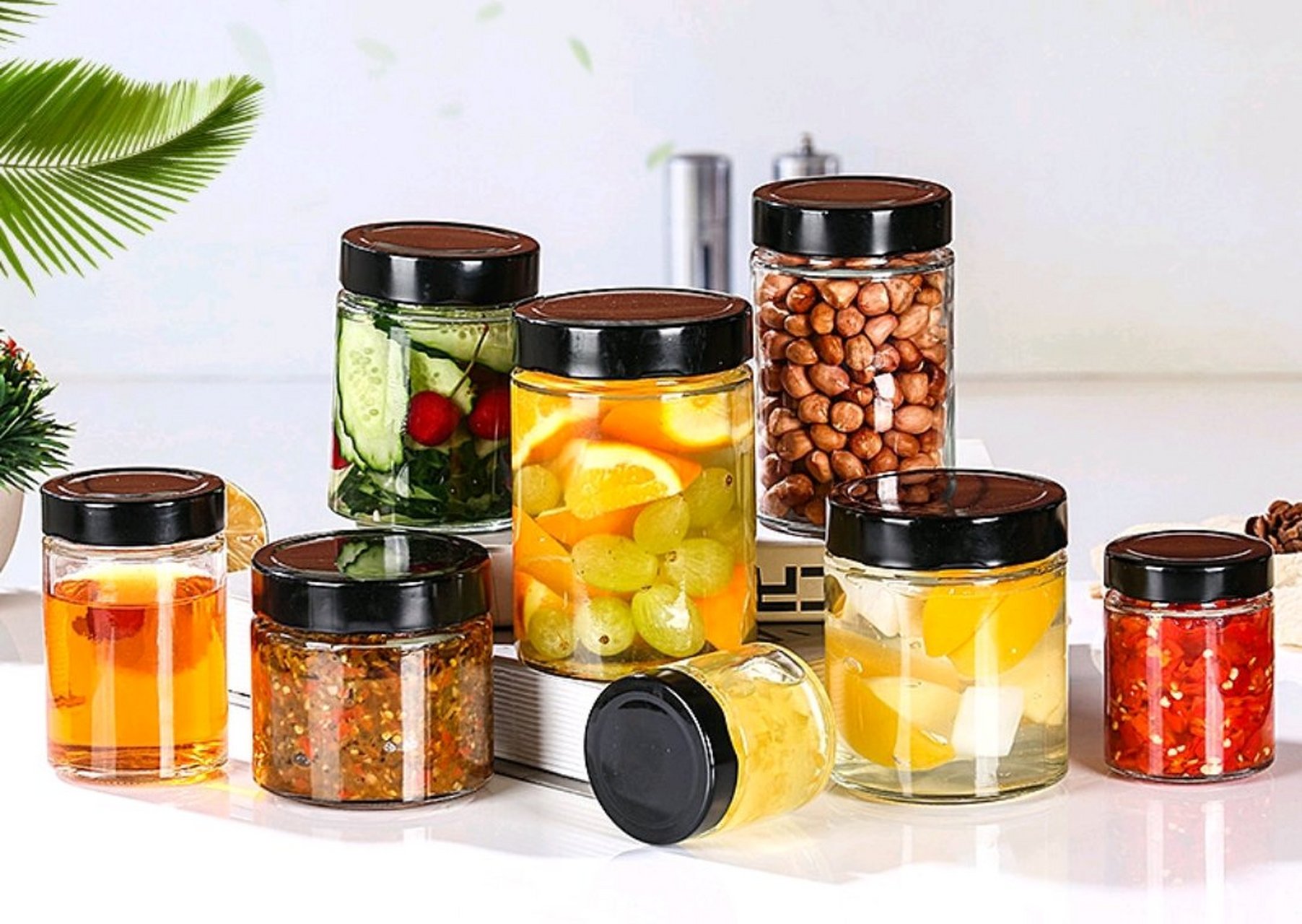
Everything about the jar is configurable. Capacity runs from 30 ml mini jam and honey-portion jars to 1 litre pickle and sauce jars. Shape is round, square, hexagonal, faceted or fully bespoke from a new mold. Decoration is screen printing with baked ceramic inks (dishwasher-durable), mold embossing (your logo formed into the glass itself), or labels for the lowest entry cost. Closures are matched and supplied together: gold or black twist-off lug lids with tamper-evident vacuum buttons, continuous-thread caps with food-grade liners, or clip-top bail closures with rubber gaskets.
Our MOQ is 1 piece on stock-mold jars. That is not a typo and not a marketing trick — it is how the glass industry works. Factories hold catalogs of hundreds of existing molds; producing from an existing mold carries no tooling cost, so a single-jar order is genuinely economical. This opens glass packaging to artisan producers, market sellers, restaurant retail and brands testing a new SKU before committing to volume. A fully bespoke shape requires new mold tooling, which we quote transparently — and we will tell you honestly when a stock body with custom printing and closures achieves the same shelf effect for a fraction of the cost.
Key Features Explained
- Chemically inert food contact — glass is the reference standard for food safety: no plasticisers, no BPA, no migration of any kind. Fatty, acidic and hot products (honey, chutney, pickles, tomato sauce) are exactly where this matters most, and glass handles all of them without a barrier layer.
- 1-piece MOQ on stock molds — buy one jar to test the fit of your product, ship samples to a co-packer, or launch a micro-batch. Reorder volumes scale up on the same mold with no retooling.
- Hot-fill and pasteurisation capable — properly annealed soda-lime glass takes 85–95 °C hot fill and water-bath processing, which PET jars cannot. The vacuum seal that forms on cooling gives the tamper-evident “popped button” customers check.
- Premium shelf presence — weight, clarity and the sight of the actual product. Honey, preserves and spice brands consistently command higher price points in glass than in plastic of the same volume.
- Infinitely recyclable — glass recycles back into glass without quality loss, and recycled cullet reduces melting energy. No other mainstream food packaging material closes the loop this completely.
- Odour and stain proof — glass does not absorb garlic, turmeric, coffee or chilli. The same jar can hold a different product next season without any residual taint.

Full Specifications
| Parameter | Specification |
|---|---|
| Material | Food-contact soda-lime flint (clear) glass; amber and opal glass available |
| Food compliance | FDA 21 CFR, EU LFGB; heavy-metal (lead/cadmium) release compliant; documentation supplied |
| Capacity range | 30 ml – 1,000 ml (stock molds); custom capacities by new mold |
| Shapes | Round, square, hexagonal, faceted/panelled, mason-style, wide-mouth, bespoke |
| Mouth type | Standard twist finish, wide mouth (60–100 mm), lug finish for twist-off lids, clip-top bail |
| Neck finishes | TO43 / TO53 / TO63 / TO66 / TO70 / TO77 / TO82 twist-off; clip-top fittings |
| Closures | Twist-off lug lids (gold/black/white/custom), continuous-thread caps with plastisol liner, clip-top with rubber gasket, corks for craft lines |
| Wall / base weight | Matched to capacity; thicker-base “weighty” versions for premium positioning |
| Thermal capability | Hot fill up to 85–95 °C; water-bath pasteurisation; thermal-shock rules apply (pre-heat before boiling contact) |
| Decoration | Screen print (baked ceramic ink, 1–4 colours), mold embossing, acid-etch effect, labels (paper/PP/textured), full-body sleeves |
| Colour of glass | Flint (clear) — standard; amber for UV-sensitive content; frosted finish optional |
| MOQ | 1 pc on stock molds; bespoke shape by new mold (typically economical from ~10,000 pcs, quoted per design) |
| Samples | Single-jar samples, mixed shape sample sets with matched lids, printed samples |
| Packing | Nested in partitioned export cartons with cell dividers; drop-test packed; lids pre-fitted or packed separately |
| Lead time | Stock molds 7–15 days (printing +3–5 days); custom mold 25–35 days including tooling |
| Shipping | Sea freight from Shanghai / Ningbo; worldwide export |
| Price range | US$0.12–1.30 / pc depending on capacity, colour, decoration and closure |
Why Glass for Food Packaging
Glass wins food packaging on four properties no other material combines, and understanding them tells you when to specify it:
1. Inertness — the zero-migration material
Glass is a frozen liquid with no free molecules to exchange with food. There is no plasticiser to migrate into fatty products, no metal to react with acid, no liner required between the wall and the food. Honey at pH 3.9, pickles in vinegar, tomato sauce simmered hot — glass treats them all identically. This is why glass is the default container for products where the producer cannot risk a taint or a compliance question.
2. Absolute barrier
Glass is a perfect barrier to gases and moisture — not a very good barrier, a perfect one. Aroma compounds that slowly escape through plastic (the reason a plastic jar of spices fades in months) stay in glass indefinitely. For honey, whose aroma is the product, and for spices and preserves, the shelf life is limited by the closure, never by the wall.
3. Thermal tolerance
Annealed soda-lime glass takes 85–95 °C hot fill and full water-bath pasteurisation — the fill-while-boiling, seal-on-cooling process that creates a vacuum and the tamper-evident popped button. This enables the classic preserving workflow that plastic jars cannot survive.
4. Perceived value
Weight, clarity and the “heft test” in the customer’s hand. A 250 g honey jar in glass reads as an artisan product; the same fill in PET reads as a commodity. Retail price points for identical contents regularly differ 20–40% between glass and plastic presentations.
The honest trade-offs
Glass is heavier (freight cost per unit is higher than PET — though the premium price usually covers it), it can break (managed with proper partitioned packing; see FAQ), and bespoke shapes need mold tooling (mitigated by the huge stock-mold catalog). We price these trade-offs into your quote rather than letting you discover them later.
Shape & Style Options
| Shape / Style | Typical Use | Shelf Effect | Relative Cost |
|---|---|---|---|
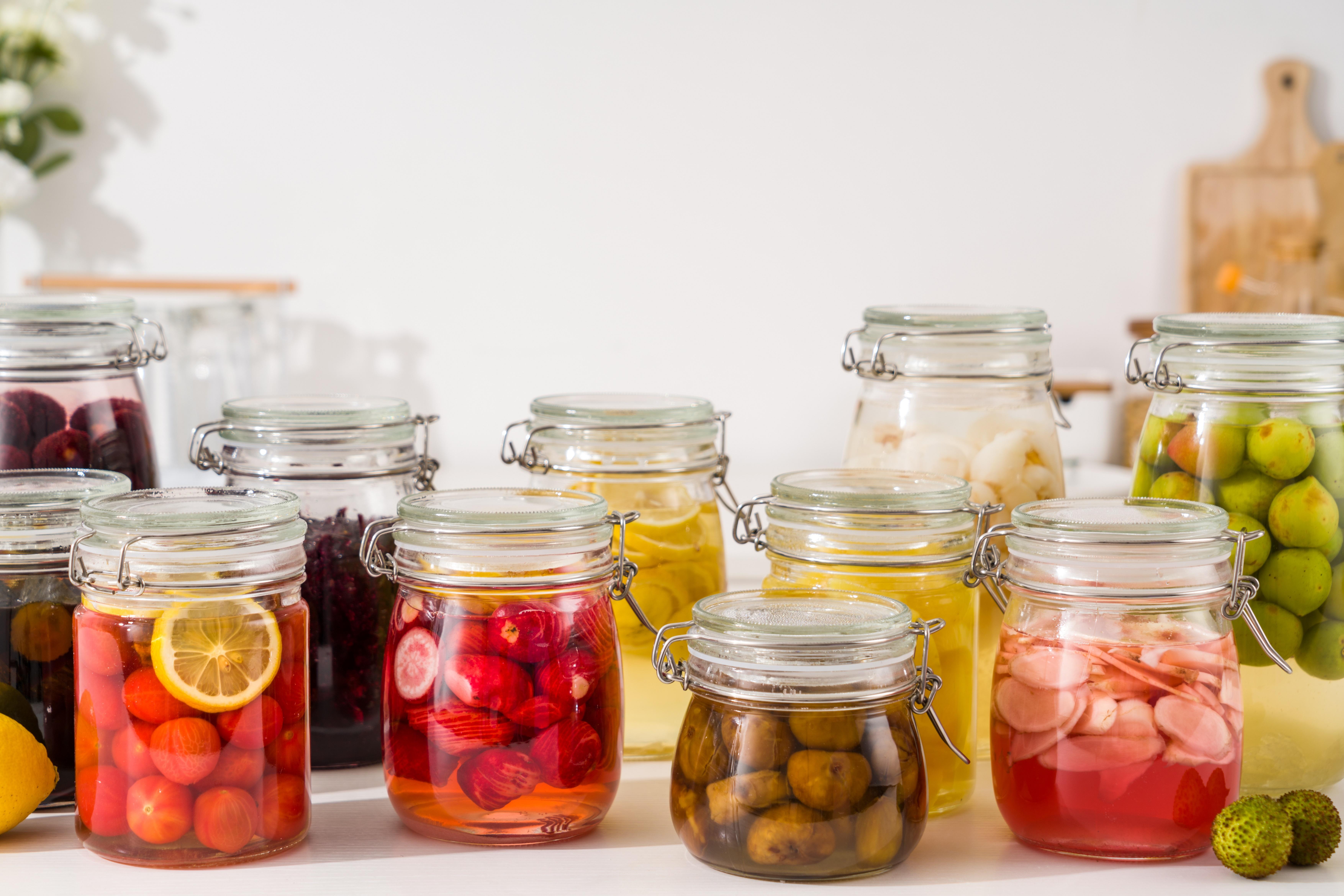
| Round wide-mouth jar | Honey, jam, chutney, sauces | Classic, high fill visibility | Lowest (most stock molds) |
| Hexagonal jar | Honey, specialty preserves, candles | Distinctive artisan signature | Low–medium |
| Square / paneled jar | Jam, spices, dry goods | Efficient shelf packing, modern look | Low–medium |
| Faceted / diamond-cut jar | Premium honey, confectionery | Light refraction, gift-tier look | Medium |
| Mason-style jar | Canning, drinks, desserts, DIY retail | Trend-driven, strong in US/EU markets | Low–medium |
| Mini portion jar (30–60 ml) | Hotel jam, honey portions, wedding favours | Cute, unit-economics friendly | Low |
| Amber jar | UV-sensitive content, apothecary look | Protective + specialty branding | Medium |
| Bespoke mold shape | Brand-owning silhouette | Unique — cannot be copied off-catalog | Mold tooling, quoted |
Capacity & Neck Finish Guide
| Capacity | Typical Fill | Common Mouth | Typical Products |
|---|---|---|---|
| 30–60 ml | ~30–80 g | TO43 / TO53 twist | Mini jam, honey portions, wedding favours, candles |
| 100–150 ml | ~120–200 g | TO53 / TO63 twist | Small-batch jam, chilli sauce, spice blends |
| 200–250 ml | ~250–350 g | TO63 / TO66 twist, wide mouth | Standard honey jar, preserves, chutney |
| 280–380 ml | ~350–500 g | TO66 / TO70 twist, wide mouth | Honey, mayonnaise, pasta sauce, pickles |
| 500 ml | ~600–750 g | TO70 / TO82 twist, wide mouth | Pickles, larger preserves, sauces |
| 720 ml – 1 L | ~1–1.5 kg | TO82 twist, clip-top | Family preserves, fermenting, beverage retail |
How to choose capacity: weigh or measure your actual fill at room temperature, add 10–15% headspace for hot-fill products (vacuum formation needs headspace), and match to the nearest stock size — moving down one stock size and filling fuller almost always looks better on shelf than a half-empty larger jar. The neck finish (e.g., TO63) is the critical matching dimension between jar and lid; we verify the seal with a fitted sample before any production run.
Closure Selection Guide
| Closure | How It Seals | Best For | Notes |
|---|---|---|---|
| Twist-off lug lid (gold/black/custom) | Lug threads engage on quarter-turn; plastisol gasket forms vacuum on cooling | Hot-filled honey, jam, sauces; retail jars with tamper evidence | The commercial standard — popped safety button is customer-checked |
| Continuous-thread cap + liner | Multi-turn thread compresses a food-grade plastisol or foam liner | Room-fill products, dry goods, reuse-oriented lines | Simplest and most resealable |
| Clip-top (bail) + rubber gasket | Wire bail clamps a porcelain or plastic top onto a rubber ring | Home preserving, fermenting, refills, premium rustic look | Re-openable countless times; gasket replaceable |
| Cork / cork-top lid | Friction fit | Candles, craft and gift lines | Not airtight — decorative use |
Lid colour is a free branding decision: gold reads traditional and premium, black reads modern, white reads clean/dairy, and Pantone-matched lids are available at volume. Gaskets and plastisol liners are food-grade on all closures we supply.
Logo & Decoration Options
| Method | How It Works | Durability | Best For |
|---|---|---|---|
| Screen print — baked ceramic ink | Ink with glass frit is screen-printed, then fired so it fuses into the surface | Dishwasher-proof, scratch-proof, will not peel | The standard for branded retail jars, 1–4 spot colours |
| Mold embossing | Logo formed into the glass itself during molding (raised or recessed) | Permanent — it is the glass | Ownable, tactile branding; pairs beautifully with a small printed label |
| Pressure-sensitive labels | Paper, transparent PP or textured stock applied after filling | Depends on label stock | Lowest cost entry, small runs, artwork changes per batch |
| Full/body sleeve | Printed shrink sleeve covering part or all of the jar | Good | Full-colour photographic branding on stock jars |
| Acid-etch / frosted effect | Surface treated for a frosted, premium matte look | Permanent | Premium and apothecary positioning |
Artwork files: vector (AI/PDF/EPS) with outlined fonts for printing; for embossing, a high-contrast logo with clear positive/negative space works best — we advise on emboss depth and line width for glass forming.
How a Glass Jar Is Made & How to Use It Right
From sand to jar — the factory process
- Batch melting — sand, soda ash and limestone are melted at ~1,500 °C into molten glass; recycled cullet (typically 30%+) lowers both cost and melting energy.
- Forming — a gob of molten glass is pressed or blown into your mold. Press-and-blow forms the jar body; the mold is the shape, which is why stock molds are free to use and new molds are the only real tooling in glass packaging.
- Annealing — the jar passes through a long lehr oven cooling it slowly and evenly. This step removes internal stress, and it is the difference between a jar that survives hot fill and one that cracks. It is the first thing our factory screening audits.
- Surface treatment — a hot-end and cold-end coating is applied to resist scratching and preserve burst strength in filling lines.
- Decoration — baked screen printing, or embossing done in-mold at step 2; inspection for defects, then dimension checks on neck finish.
- QC & packing — capacity, wall thickness and thread-gauge checks; jars nested with cell dividers into drop-test-packed export cartons.

Using the jar right — the producer’s rules
- Inspect the rim — run a finger around the sealing edge before filling. Even a small chip breaks the vacuum seal; this single check prevents most “my jam spoiled” failures.
- Pre-heat before hot fill — warm jars with hot water to narrow the temperature gap; fill hot product into warm jars.
- Leave headspace — 10–15% for hot-fill; the vacuum that forms on cooling needs air space to pull against.
- Cap while hot, then listen — the lug lid’s safety button pops down as the content cools and contracts. A jar whose button stays up did not seal: refrigerate and use first.
- Pasteurise if required — water-bath processing works in properly annealed jars; never subject a cold jar straight from a cold room to boiling water.
- Cool upright on a dry rack — never on stone or wet steel; label only after the jar has reached room temperature.

Applications & Fit
| Product category | Recommended spec | Fit rating |
|---|---|---|
| Honey | Round or hexagonal, 250–500 g, TO63/TO70 twist-off, gold lid | Excellent — the classic |
| Jam, preserves, marmalade | Round/square 100–380 ml, twist-off with tamper button | Excellent |
| Pickles & fermented foods | Wide mouth 500–1 L, strong walls, twist or clip-top | Excellent — acid-proof |
| Chilli sauce, chutney, pasta sauce | 250–380 ml, hot-fill spec, TO66/TO70 | Excellent |
| Spices & dry blends | 100–150 ml square jar, continuous-thread cap | Very good |
| Candles & home fragrance | Round/hexagonal stock jar, cork or lid, printed or embossed | Very good |
| Beverage retail (cold brew, kombucha) | 720 ml–1 L with TO82 or clip-top; check lid seal for carbonation first | Good (non-carbonated best) |
| Wedding favours & gifts | Mini 30–60 ml jars, printed or labelled | Very good |
| Carbonated drinks | Requires pressure-rated jar + specific closure — consult us before ordering standard stock | Special spec only |
Glass Jar vs. PET Jar vs. Tinplate Can
Three containers, three different cost/visibility/processing profiles. Choose by what your product needs, not by habit:
| Dimension | Glass Jar (this product) | PET Plastic Jar | Tinplate Can |
|---|---|---|---|
| Chemical inertness / migration | Zero migration, no liner | Very good with food-grade PET | Needs internal lacquer lining |
| Aroma & moisture barrier | Perfect barrier | Very good, not perfect | Excellent |
| Product visibility | Full, with premium clarity | Full | None — label-only |
| Hot fill / pasteurisation | 85–95 °C, water-bath capable | Deforms above ~60–70 °C | Full retort capable |
| Perceived value on shelf | Highest — weight and clarity | Light, commodity feel | Traditional, value feel |
| Unit cost | Medium (US$0.12–1.30) | Lowest | Low–medium |
| Weight / freight | Heaviest — highest freight per unit | Lightest | Light |
| Breakage risk | Managed with partitioned packing | None | Dents, rarely fails |
| Reusability by consumer | Endlessly — jars live on in kitchens | Limited | Open-only, sharp edges |
| Recyclability | Infinite, closed-loop | Code 1 stream, downgrades | Metal stream, very good |
| Best for | Premium, artisan, acidic/hot products | Volume, lightweight distribution | Long-shelf-life staples |
Frequently Asked Questions
What is the MOQ, and can I really order just 1 glass jar?
Yes — for any jar made from an existing stock mold, our MOQ is 1 piece. Glass factories hold catalogs of hundreds of ready molds, and producing from an existing mold has no tooling cost, so a single-jar order is economical. This makes 1-piece MOQ ideal for sampling, label-and-brand testing, small-batch artisan producers and market sellers. A fully bespoke shape is different: it requires a new mold, and new molds are typically economical from around 10,000 pcs (we quote the exact break-even for your design).
Can you make a custom jar shape that is not in your catalog?
Yes. Send us a sketch, a reference jar, or your product and target weight; our glass factory engineers produce 3D drawings and a mold, then a pre-production sample for your approval before mass production. Custom shapes include unique silhouettes, embossed panels, custom thread profiles and special closures. Note the mold is a one-off tooling cost — we advise honestly when an existing mold can be adapted more cheaply, because for many projects a stock body plus a custom-printed or custom-lidded finish achieves the shelf look at a fraction of the tooling cost.
Is the glass food-safe and suitable for hot filling?
Yes. Our jars are made of food-contact soda-lime glass that is chemically inert — it does not leach, does not absorb food colours or odours, and needs no liner between glass and food. We supply FDA 21 CFR and EU LFGB compliance documentation. Properly annealed soda-lime glass handles hot filling at up to about 85–95 °C and water-bath pasteurisation. Two rules apply: pre-heat the jar before contact with boiling content (thermal shock, not heat itself, cracks glass), and never place a hot jar on a cold wet surface.
How do you print a logo on glass, and does it survive washing?
Three main methods. Screen printing with baked ceramic-based inks is the standard for branded jars — the ink is fired onto the surface, so it survives dishwashers, rubbing and oil without peeling; 1–3 spot colours are most economical. Mold embossing puts your logo into the glass itself during forming — permanent, tactile, and no ink at all, but it requires a custom or modified mold. Pressure-sensitive labels (paper, transparent PP or textured stock) are the lowest-cost route for small runs. We will recommend based on your volume, budget and whether jars need dishwasher durability.
Which closure should I choose — twist-off, lug, or clip-top?
It depends on how the jar will be used. Twist-off lug lids (the gold or black caps on commercial honey and jam jars) give a tamper-evident vacuum seal after hot filling — the safety button pops down, which customers instinctively check. Continuous-thread closures with a plastisol liner are the simplest resealable option for room-fill products. Clip-top (bail) jars with rubber gaskets are the classic home-preserving and reuse-oriented closure. We supply matched lids with the correct neck finish for every jar, and the lid gasket compound is food-grade.
How do you prevent breakage during international shipping?
Jars ship nested in partitioned export cartons, with cell dividers separating each jar and void fill at the head space. Typical configurations: individual cells for premium and printed jars, or bulk nesting with layer pads for economy. Every shipment is drop-test packed, and we can add your lid pre-fitted or packed separately to avoid thread pressure. Breakage rates in properly packed container shipments are very low, and claims are handled within 24 hours with photo documentation.
What capacities and neck finishes are available?
Stock molds cover the full commercial range: 30–60 ml mini jars for jams, honey portions and candles; 100–250 ml for honey, jams and chutneys; 280–380 ml standard honey and preserve sizes; 500–720 ml for pickles, sauces and larger preserves; up to 1 L. Common neck finishes include TO43, TO53, TO63, TO66, TO70, TO77 and TO82 twist-off sizes plus clip-top fittings — the neck finish is the critical dimension because it must match the closure exactly, and we verify lid-to-jar fit with a sealing sample before production.
Can I get samples before ordering?
Yes — and this is exactly what the 1-piece MOQ makes easy. We can ship a single sample jar, a full sample set of candidate shapes with matched lids, or a printed sample so you can check the logo quality in hand. Sample cost is minimal because stock molds run in single-piece quantities. For custom mold projects, we provide 3D renderings first and a physical pre-production sample for approval before the production run.
What is the lead time?
Stock mold jars: 7–15 days production after order confirmation, depending on quantity and decoration (printing adds 3–5 days over plain jars). Custom mold projects: approximately 25–35 days total — mold making 10–15 days plus production and decoration. Sea freight from Shanghai or Ningbo ports; we quote the full door-to-door timeline per destination when quoting.
OEM & Our Services
JAJA Packing is a professional OEM & ODM packaging service provider — a packaging supply chain integrator and exporter with a network of over 1,200 partner factories, 20+ product categories and 20,000+ packaging designs. We manage the entire process: supplier screening, price comparison, prototyping, quality control, delivery scheduling and final export. Glass is a category where annealing quality, neck-finish precision and decoration firing separate a premium jar from a complaint magnet — exactly what our factory screening and QC process exist to control.
| Service Item | Details |
|---|---|
| Customization scope | Shape (stock or bespoke mold), capacity (30 ml–1 L), glass colour (flint/amber/frosted), neck finish, closure, decoration method |
| Design support | Free 3D drawings for custom shapes, mold engineering, sealing-fit verification, artwork placement; samples in single-piece quantities |
| MOQ | 1 pc on stock molds; bespoke shape by new mold, break-even volume quoted per design |
| Quote speed | Quote within 24 hours of receiving specifications |
| Compliance support | FDA, LFGB, REACH, RoHS, ISO certificates and SGS test reports assisted |
| Factory audits | On-site factory inspections and virtual audits welcome |
| After-sales | Any questions or claims answered within 24 hours |
| Payment & shipping | Flexible terms; loading from Shanghai or Ningbo ports; worldwide export |