

Product Description
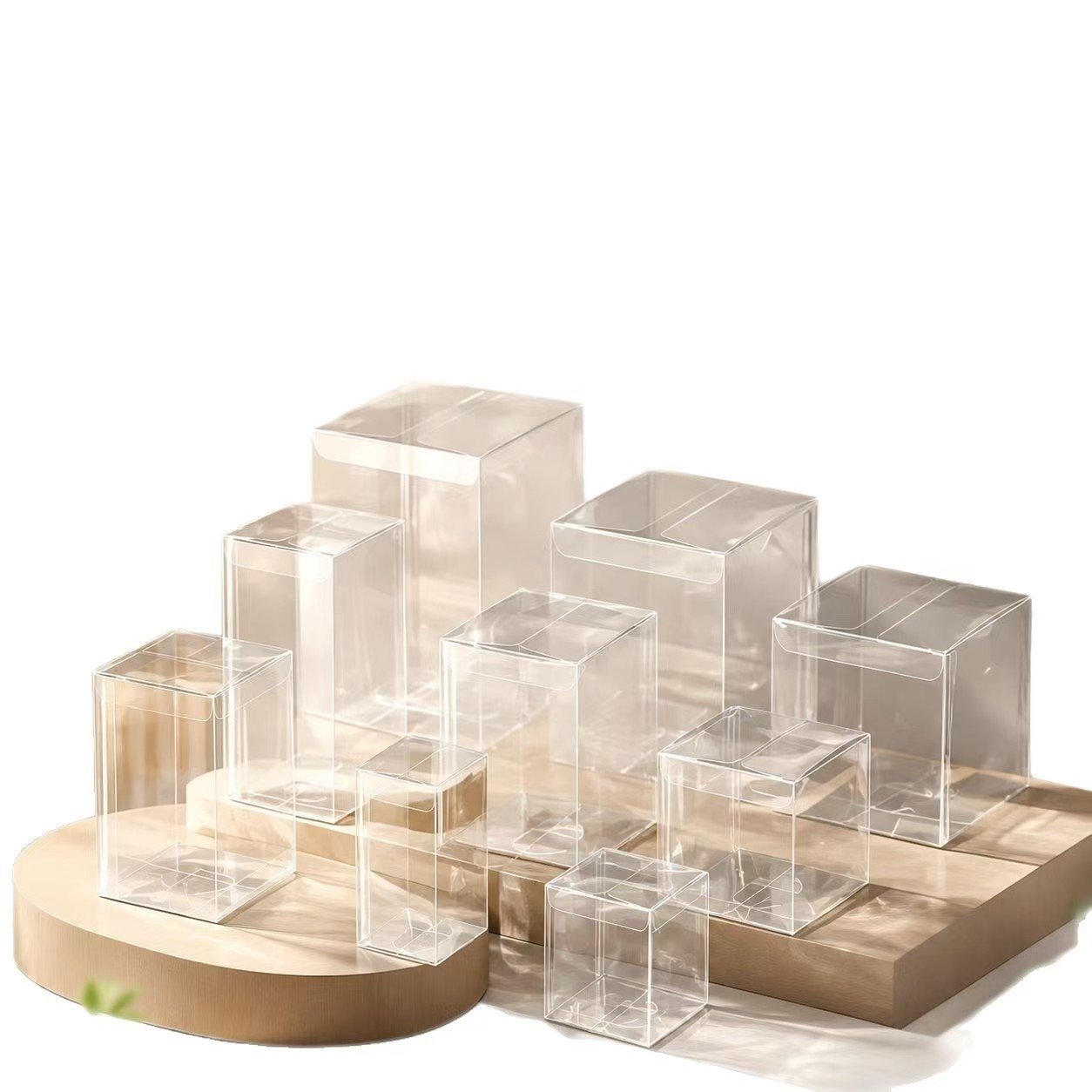
This is a transparent folding box made from rigid food-grade PET sheet — a plastic carton that behaves like paperboard. The flat sheet is die-cut and creased with precise fold rules, so it ships flat and folds into a finished box in seconds, usually with no glue at all. Because the walls are crystal clear, the customer sees the actual product from every angle before buying — which is exactly why cosmetics, confectionery, electronics accessories and gift sets keep choosing it over printed cartons.
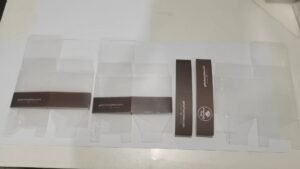
Everything is made to order. You give us the product dimensions and the look you want; we produce the die-line, a plain sample to test the fold, then the production run. Sheet thickness runs from 0.25 mm for small cosmetic cubes to 0.6 mm for large or heavy boxes, in PET, PETG or PP depending on how the box will be used. Your logo and artwork go on by silk-screen for bold spot colours or UV offset for full photographic print, with hot foil stamping and frost effects for premium ranges.

Our MOQ is 1,000 pieces. That number exists for a simple reason: clear folding boxes need a custom steel cutting die and creasing rules for your exact dimensions, and the one-off die cost needs a meaningful run to spread over. The die is yours for reuse — we store it, and every reorder carries zero tooling cost. For large repeat programmes above roughly 5,000 pcs, the unit price steps down significantly.
Key Features Explained
- 360-degree product visibility — the entire selling point. Where a printed carton asks the customer to trust the picture, a clear box shows the real thing: the colour, the finish, the quality.
- Carton-like folding behaviour — precision creasing rules mean crisp folds without whitening on PETG and PP, and tabs that lock square without glue. Fold quality is where cheap and good clear boxes separate visibly.
- Flat-pack economics — a flat clear box occupies roughly a tenth of its erected volume. Export freight, warehouse space and inbound handling all price on the flat, not the erected, footprint.
- Food-contact safe — PET and PP are standard food-contact plastics; we supply FDA and LFGB documentation, and the glue-free fold keeps the interior surface clean.
- Printing that works on clear — outside print, reverse print on the inner face (scratch-protected), white ink underlays for opacity, and the signature premium move: a white panel with your logo knocked out in clear so the product shows through the lettering.
- Protective film handling — sheets arrive with PE protective film; we print with film in place and strip it after production, so surfaces reach you factory-fresh.
Full Specifications
| Parameter | Specification |
|---|---|
| Product name | Custom clear PET folding box / transparent plastic box with printed logo |
| Materials | PET (standard), PETG (impact & crease enhanced), PP (repeated-open applications); all food-contact grades available |
| Sheet thickness | 0.25 / 0.3 / 0.35 / 0.4 / 0.45 / 0.5 / 0.6 mm |
| Size range | Fully custom — typical 40 × 40 × 40 mm up to 400 × 300 × 300 mm |
| Box styles | Tuck-flap top, auto-bottom, hinged lid, sleeve-and-tray, book-style, cylinder (rolled), heart/hexagon/custom die-cut |
| Construction | Die-cut with creasing rules; glue-free tab lock standard; glue or ultrasonic weld optional for permanent units |
| Printing | Silk-screen (1–3 spot colours, most economical) · UV offset (full-colour CMYK, photographic) · digital for short-run proofs |
| Print placement | Outside face, reverse print on inner face (scratch-protected), white ink underlay for opacity |
| Premium finishes | Hot foil stamping (gold / silver / rose gold / coloured), frost or frosted-panel effect, embossing effect |
| Surface protection | PE protective film on one or both sides; removed after printing and forming |
| Clarity | ≥90% light transmission (PET); frost effect on request |
| Food contact | FDA 21 CFR and EU LFGB compliance documentation supplied; glue-free interior |
| Temperature range | PET: −20 to +60 °C service · PP: −20 to +100 °C (microwave-safe grades on request) |
| Recyclability | PET = code 1 stream · PP = code 5 stream · PVC available but restricted in some markets |
| Artwork required | AI / PDF / EPS vector, outlined fonts, spot colours or CMYK defined, 300 dpi images; die-line supplied by us |
| Certifications | FDA, LFGB, REACH, RoHS, ISO; SGS test reports on request |
| MOQ | 1,000 pcs per design; cutting die one-off and stored free for reorders |
| Sample | Plain structural sample 3–5 days; printed sample 5–8 days; sample cost credited against bulk order |
| Lead time | 10–15 days after sample approval, plus shipping |
| Packing | Flat-nested in export cartons; assembly guide included |
| Shipping | EXW / FOB Shanghai or Ningbo; worldwide air and sea freight arranged |
PET vs. PVC vs. PP — Choosing the Sheet
Three plastics can make a clear folding box. They are not interchangeable, and the wrong choice usually shows up six months later:
| Dimension | PET / PETG (this product) | PVC | PP |
|---|---|---|---|
| Clarity | Crystal, ≥90% transmission | Very good | Good, slightly hazier |
| Food-contact status | Standard, FDA / LFGB documented | Restricted in many markets | Standard, FDA / LFGB documented |
| Recyclability | Code 1 — widely recycled | Code 3 — increasingly rejected | Code 5 — recyclable where collected |
| Crease-fold life | Folds well; repeated flexing can whiten | Good | Best — thousands of open/close cycles |
| Impact resistance | Good (PETG better) | Good | Very good |
| Heat tolerance | Up to ~60 °C | Up to ~60 °C | Up to ~100 °C, microwave grades |
| Relative cost | Medium | Lowest | Medium |
| Best for | Retail boxes opened once by the consumer | Cost-driven non-food, where accepted | Storage boxes, organisers, daily-open packs |
Thickness Selection Guide
| Thickness | Box size | Load | Typical use |
|---|---|---|---|
| 0.25–0.3 mm | Up to ~100 mm | Up to ~200 g | Cosmetics, jewellery, cards, small confectionery |
| 0.35–0.4 mm | 100–200 mm | 200–800 g | Electronics accessories, gift sets, candles, toys |
| 0.45 mm | 150–300 mm | 0.8–1.5 kg | Standard all-rounder for mid-size retail boxes |
| 0.5–0.6 mm | 200–400 mm | 1.5–3 kg | Large gift boxes, multi-packs, display units |
Two Quick Checks Before You Decide
- The sight-line test: stand the empty box on its base and look straight down the walls. Visible bowing means go one thickness up — bowed walls are the number-one reason clear boxes read as “cheap” on a premium product.
- The finger test: press the top panel with one finger. If it visibly flexes under light pressure, the lid will dent in a shipping carton. Move up a thickness or shorten the span.
Size Guide by Application
Every box is cut to a die-line built from your product. These are the sizes we are asked for most:
| Application | Typical inner size (L × W × H) | Thickness | Style |
|---|---|---|---|
| Lipstick / cosmetic mini | 35 × 35 × 110 mm | 0.3 mm | Tuck flap |
| Cosmetic cube (jar, cream) | 60 × 60 × 60 mm | 0.3 mm | Tuck flap |
| Candy / chocolate box | 100 × 60 × 150 mm | 0.35 mm | Tuck flap or hinged lid |
| Phone case / accessories | 100 × 30 × 180 mm | 0.35 mm | Tuck flap with hang hole |
| Candle / gift jar | 90 × 90 × 110 mm | 0.4 mm | Auto-bottom tuck |
| Small toy / figurine | 120 × 90 × 180 mm | 0.4 mm | Tuck flap |
| Bath bomb / gift set | 200 × 150 × 60 mm | 0.45 mm | Sleeve and tray |
| Large gift / multi-pack | 300 × 200 × 100 mm | 0.5–0.6 mm | Hinged lid or tuck flap |
How to Measure Your Product
- Measure the product at its widest point, including any blister, wrap or hanger.
- Add 1–2 mm clearance per side — enough to slide the product in, not enough to rattle.
- Add sheet thickness to each outer dimension for shelf and shipper fit.
- Decide the opening orientation — top tuck, side opening or front flap — before the die-line is drawn.
- Send the numbers or a sample; we draw the die-line and return it for approval.
Logo & Printing Options on Clear Plastic
Printing on clear material has its own logic — you are designing with transparency, not just on it. Here is the full menu:
| Method / Effect | What it does | Best for |
|---|---|---|
| Silk-screen print | Bold spot-colour print, 1–3 colours, opaque inks | Logos and simple graphics — most economical per print |
| UV offset print | Full-colour CMYK and photographic artwork directly on the sheet | Image-heavy designs, gradients, product photography |
| Reverse print (inner face) | Artwork printed on the inside surface, seen through the wall | Scratch-proof artwork, deeper-looking colour |
| White ink underlay | White base under colours so they stay opaque on clear | Any coloured logo — clear plastic mutes colour without it |
| Knock-out logo | White panel printed with the logo left clear — product shows through the lettering | The signature premium move on clear boxes |
| Hot foil stamping | Gold, silver, rose gold or coloured metallic foil | Luxury ranges — pairs perfectly with a white panel |
| Frost effect | Frosted panel or band printed to contrast with clear walls | Modern cosmetic and tech looks; hides fingerprints |
| Hang hole / euro slot | Die-cut slot for pegboard display | Retail hanging SKUs |
How It Is Made — And How to Fold It
From brief to shipment
- Send the product spec — dimensions, weight, and how the box will open (top tuck, side, hinged).
- Material and thickness selection — PET, PETG or PP by usage; thickness by size and load, per the guides above.
- We issue the die-line — the exact cutting and creasing template for your artwork, free of charge.
- Artwork placement — outside, reverse, white underlay, knock-out, foil: laid out on the true die-line.
- Plain sample first — test the fold with your real product inside before any printing.
- Printed sample — colour approval on the actual sheet; clear-material colours always need a physical check.
- Tooling — steel cutting die and creasing rules made for your design; one-off, stored free for reorders.
- Printing — silk-screen or UV offset on the sheet, protective film in place.
- Die-cutting and creasing — panels, tabs, hang holes and fold rules cut in one stroke.
- Film removal and QC — protective film stripped, clarity and fold inspected piece by piece.
- Flat nesting and packing — boxes flat-nested into export cartons with assembly guides.
- Shipment — FOB Shanghai or Ningbo, or door-to-door air and sea freight arranged.
Folding the box (what your packing line or the customer does)
- Peel off any remaining protective film on the faces you want presentation-clean.
- Fold the four side walls up along the creases — the rules make the folds crisp and square.
- Lock the bottom tabs (or fold the auto-bottom) — no glue on standard designs.
- Insert the product, then close the tuck flap or hinged lid until it clicks square.
- Done in under 10 seconds — no tools, no tape, no glue gun.
Applications & Fit
| Product category | Recommended spec | Fit rating |
|---|---|---|
| Cosmetics & skincare | PET 0.3–0.4 mm, tuck flap, white panel + foil logo | Excellent |
| Confectionery & chocolate gift boxes | PET 0.35–0.45 mm, hinged or tuck lid | Excellent |
| Electronics accessories | PET 0.35 mm, hang hole, reverse-print artwork | Excellent |
| Toys & collectibles | PET 0.4–0.5 mm, display-style box | Excellent |
| Candles & home fragrance | PET 0.4 mm, auto-bottom | Excellent |
| Stationery & gift cards | PET 0.25–0.3 mm, tuck flap | Very good |
| Food (bakery, dried food, gift food) | Food-grade PET/PP with FDA/LFGB docs | Very good |
| Storage boxes opened daily | Switch to PP — crease life thousands of cycles | Good (material: PP) |
| Hot-filled or pasteurised products | PP only; PET deforms above ~60 °C | Specify material first |
Clear PET Box vs. Paper Box vs. Blister Pack
All three show the product. They differ in cost, shelf presence and what they ask of your supply chain:
| Dimension | Clear PET Folding Box (this product) | Printed Paper Box | Blister Pack (card + shell) |
|---|---|---|---|
| Product visibility | Full 360° | Window only (optional) | Front view, formed to shape |
| Perceived value | High — glass-like and weightless | High with premium finishes | Mass-market feel |
| Protection | Good, rigid walls | Good with correct board | Best — product locked in shell |
| Branding space | Print panels on clear surfaces | Full wrap, largest canvas | Printed backing card only |
| Unit cost | Medium (US$0.20–1.80) | Low–medium | High — shell tooling per shape |
| Tooling | One cutting die, reusable | One cutting die, reusable | Formed mould, expensive per shape |
| Freight efficiency | Ships flat, ~10% volume | Ships flat | Ships bulky, formed |
| Recyclability | Code 1 (PET) stream | Paper stream | Mixed material, hard to recycle |
| Best for | Premium products that sell on appearance | Brand-led products, largest print canvas | Security-heavy small items, pegboard |
Frequently Asked Questions
What is a clear PET folding box?
It is a box made from rigid transparent plastic sheet — typically 0.25 to 0.6 mm PET — that is die-cut with fold lines (creases) so it folds together like a paperboard carton, usually without glue. It arrives flat, folds into shape in seconds, and gives complete 360-degree visibility of the product inside. PET is the same family of plastic as beverage bottles: crystal clear, food-contact safe and recyclable.
What is the MOQ, and why is it 1,000 pieces?
Our MOQ is 1,000 pcs. Clear folding boxes require a custom cutting die and creasing rules set up for your exact dimensions, so the one-off die cost has to be spread over a meaningful quantity — below that, the per-unit price stops making sense. The die is reusable on reorders, and we store it so repeat orders carry no tooling cost. For volumes above roughly 5,000 pcs the unit price drops significantly.
PET, PVC or PP — which material should I choose?
PET (and PETG) is the default choice: the clearest of the three, food-contact safe with FDA/LFGB documentation, and recyclable in the code-1 stream. PVC is cheaper and slightly easier to crease, but many retailers and markets restrict it on environmental grounds. PP is the choice where the box will be opened and closed repeatedly — its creases flex thousands of times without whitening, where PET creases can show stress whitening after repeated flexing. If the box is opened once by the consumer, choose PET; if it is a storage-style box opened daily, choose PP.
Can you print my logo on transparent plastic?
Yes. The two main methods are silk-screen printing (bold spot-colour logos, most economical for 1–3 colours) and UV offset printing (full-colour CMYK and photographic artwork directly on the sheet). We also offer hot foil stamping in gold, silver and coloured foils, frost or frosted-effect printing, and white ink backing under colours so they stay opaque on clear material. A common premium look is a white printed panel with the logo knocked out in clear — the product shows through the logo itself.
What thickness should I choose?
0.25–0.3 mm for small lightweight boxes up to about 100 mm; 0.35–0.45 mm for medium boxes and anything carrying 500 g or more; 0.5–0.6 mm for large boxes, heavy contents and tall units where the walls must not bow. Two quick checks before choosing: stand the box on its base and look down the walls for bowing, and press the top panel — if it visibly flexes under light finger pressure, go one thickness up.
Is the box food-safe?
Yes, when specified in food-grade PET or PP. We supply FDA 21 CFR and EU LFGB compliance documentation with food-contact orders. Note that printing inks sit on the outside surface and the crease-and-fold construction means no adhesive is inside, which keeps the food-contact path clean. For direct contact with oily or high-fat foods we recommend a food-grade insert or inner wrap, as we would with any rigid packaging.
How do the boxes ship and assemble?
They ship completely flat, nested in export cartons — a flat clear box occupies roughly a tenth of its erected volume, which is what keeps export freight economical. Assembly takes seconds: the creased panels fold along the rules and the tabs lock into place, glue-free on most designs. Every order includes an assembly guide, and a plain sample is available so your team can test the fold before production.
Why does the surface have a protective film, and should I remove it before printing?
Clear plastic carries a static charge and attracts dust and fine scratches, so sheets are supplied with a protective PE film on one or both sides. We print through or onto the sheet with the film in place and remove it after production, so the surfaces you see in the finished box are untouched factory surfaces. We recommend leaving the film on the inner face until the product is packed — it protects against scuffs during transport and handling.
What artwork files do you need for a clear box?
Vector files — AI, PDF or EPS with outlined fonts, spot colours or CMYK defined, and 300 dpi for any images. Because the substrate is clear, artwork needs to think in layers: we will ask whether each element prints on the outside face, the inside face (reverse printing, protected from scratching), or as a white ink underlay. We supply the die-line for your exact dimensions and help you place the artwork on it at no charge.
OEM & Our Services
JAJA Packing is a professional OEM & ODM packaging service provider — a packaging supply chain integrator and exporter with a network of over 1,200 partner factories, 20+ product categories and 20,000+ packaging designs. We manage the entire process: supplier screening, price comparison, prototyping, quality control, delivery scheduling and final export. Clear folding boxes are a category where small differences — crease quality, film handling, print registration on clear material — separate a premium result from a cheap one, and those differences are exactly what our factory screening and QC process exist to control.
| Service Item | Details |
|---|---|
| Customization scope | Size, shape, material (PET / PETG / PP), thickness (0.25–0.6 mm), box style, printing method, foil, frost and finishes |
| Design support | Free die-line, structural design and artwork placement on clear material; plain and printed samples before production |
| MOQ | 1,000 pcs per design; cutting die one-off and stored free for reorders |
| Quote speed | Quote within 24 hours of receiving specifications |
| Compliance support | FDA, LFGB, REACH, RoHS, CE, ISO certificates and SGS test reports assisted |
| Factory audits | On-site factory inspections and virtual audits welcome |
| After-sales | Any questions or claims answered within 24 hours |
| Payment & shipping | Flexible terms; loading from Shanghai or Ningbo ports; worldwide export |