
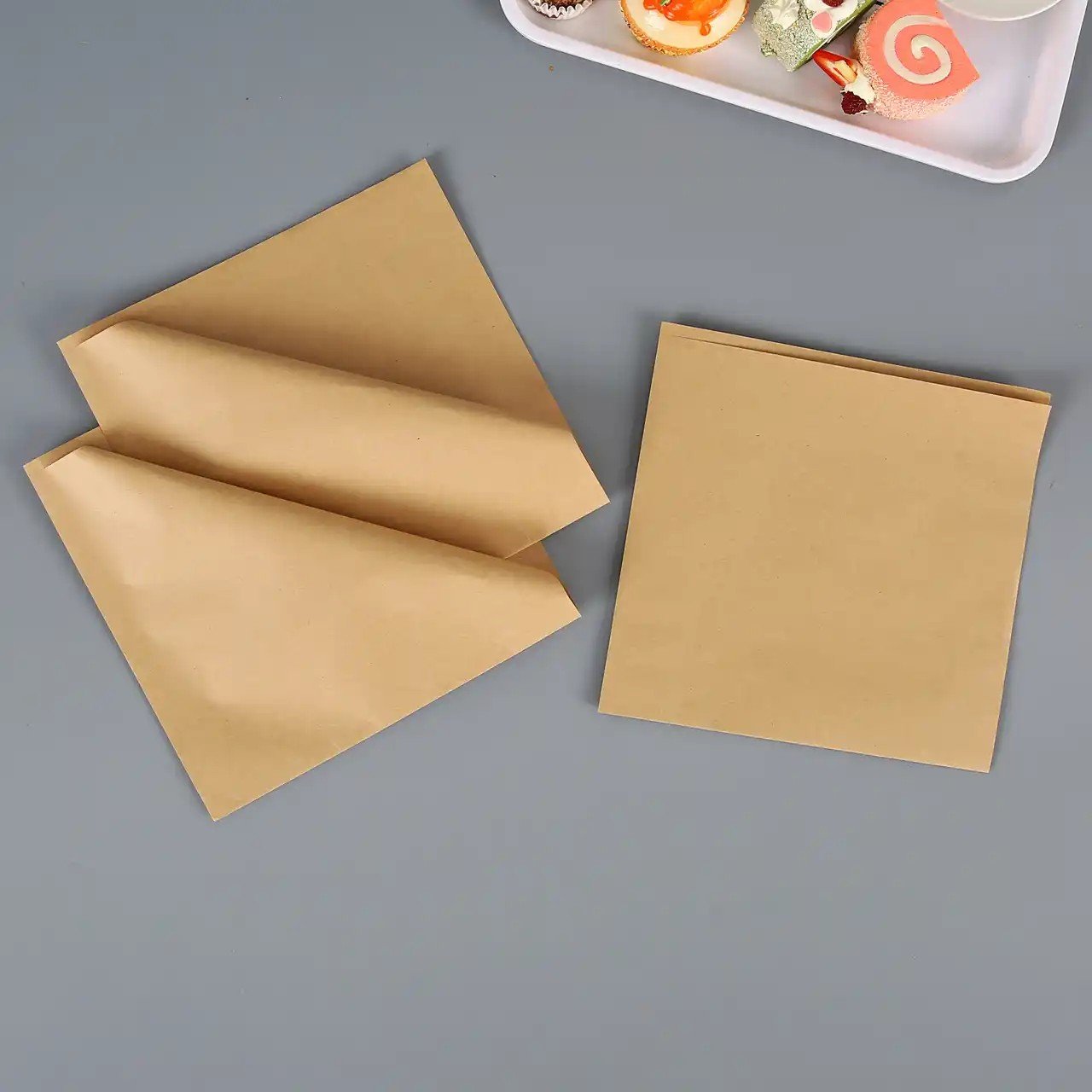
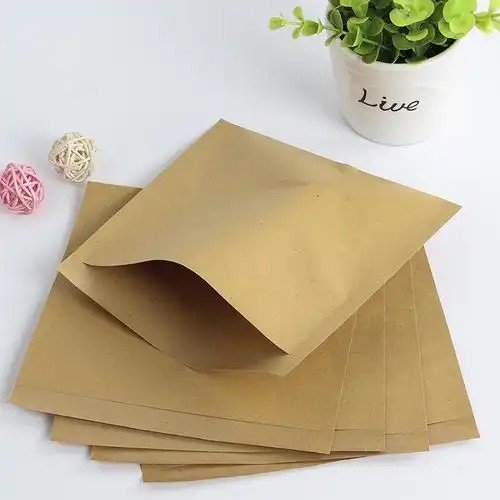
Product Overview

JAJA Packing, based in Huzhou, Zhejiang, China, is a professional OEM & ODM packaging service provider. We match every project against a network of over 1,200 partner factories, so this simple bag — like every product we ship — is produced on the line that best fits your size, quantity, target price and delivery schedule.

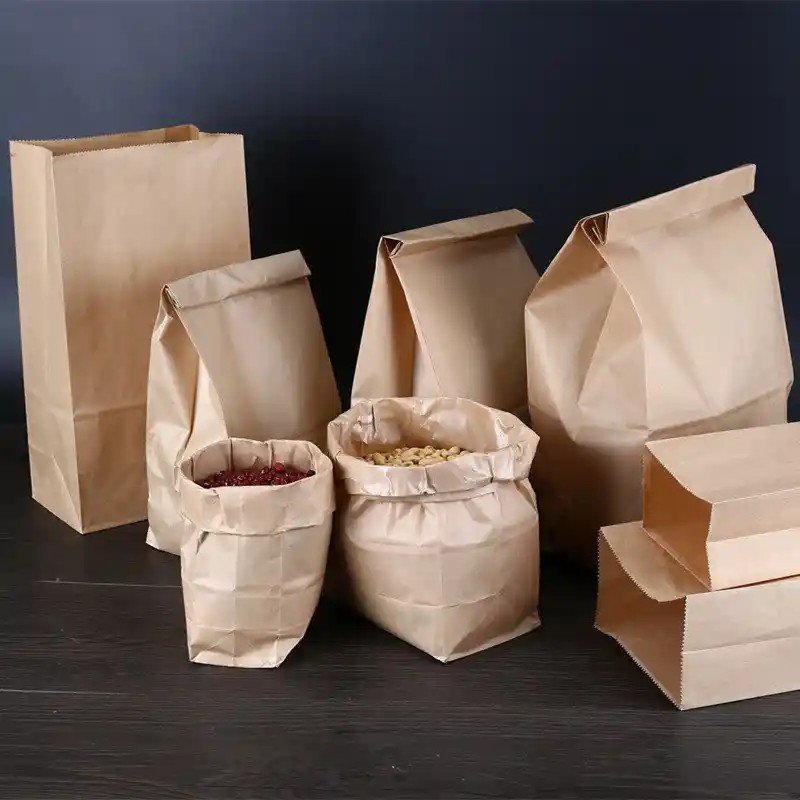
This is the “ordinary” kraft bag by design: no window, no zipper, no laminate. That simplicity is its advantage. It is the cheapest paper format per unit, it runs on high-speed lines (fast lead times at any volume), the uncoated paper is fully recyclable in the paper stream, and the open top suits both counter service (grab-and-go) and machine filling with a heat-seal close.

Compliance is confirmed project by project: FDA 21 CFR and EU LFGB for food contact, REACH and RoHS for EU shipments, FSC chain-of-custody for the paper. On-site factory inspections and virtual audits are welcome.
Full Specifications
| Parameter | Specification |
|---|---|
| Product name | Food-Grade Kraft Paper Bag (Open-Top) |
| Styles | Flat bag (three-side sealed) · Block-bottom / SOS bag · Square-bottom bag · Pinch-bottom bag |
| Paper weight | 40–90 gsm food-grade kraft (natural brown; white kraft on request) |
| Barrier options | Standard uncoated · Grease-resistant (glassine or fluorine-free oil barrier) · Water-resistant coating on request |
| Flat bag sizes | 80 × 120 mm up to 250 × 350 mm |
| Block-bottom bag sizes | 90 × 60 × 220 mm up to 320 × 180 × 460 mm (W × D × H) |
| Filling capacity | 20 g single-serve up to 3–5 kg grocery portions (style dependent) |
| Top closure options | Fold-top · fold + sticker/label · fold + clip · heat-seal strip (machine filling) · pinch-bottom glued close |
| Bottom options | Flat sealed · block bottom (self-standing) · square bottom · satchel bottom |
| Side gusset | Optional on flat bags; standard on block-bottom styles |
| Printing | Flexo 1–4 colors (short runs) · rotogravure up to 8 colors (large runs) · food-safe inks |
| Food-contact compliance | FDA 21 CFR, EU LFGB — test reports available on request |
| Other certifications | FSC (paper), REACH, RoHS; supplier network holds ISO 9001, BSCI, ISO 45001 |
| Recyclability | Uncoated kraft is recyclable in the standard paper stream and compostable |
| Temperature tolerance | Suitable for hot fill-out (takeaway) service; no plastic liner to melt or off-gas |
| Typical price range | US$0.01–0.15/pc (size, paper weight and print dependent — request a formal quote) |
| MOQ | Blank/stock: from sample quantities · 1–2 color print: typically from 1,000 pcs · full-color: from ~5,000 pcs |
| Lead time | Stock: 3–7 days · Custom printed: 10–18 days after artwork approval |
| Ports of loading | Shanghai / Ningbo, China |
How It Works: Flat Bag vs. Block-Bottom Bag
1. The Flat Bag — Simplest Structure, Lowest Cost
A flat kraft bag is a tube of paper with a center-seam (side-seam) construction, sealed across the bottom and open at the top. With no gusset and no base fold, it uses the least material of any paper bag and runs fastest on converting lines — which is why it is the default for single-serve portions, cookie packs, sachets and lightweight retail items. It lies flat when empty, which also makes it the most compact format to ship and store: 10,000 flat bags occupy a fraction of the carton space of 10,000 standing bags.
2. The Block-Bottom (SOS) Bag — Standing Volume
The block-bottom bag folds a rectangular base panel and side gussets into the tube, creating a 3D box-like cavity — the classic SOS (self-opening sack) used for takeaway, groceries and bread loaves. The same sheet of paper now holds its shape when filled and stands on the counter, so staff can fill it one-handed and customers can carry it upright. Load capacity rises sharply because the base panel distributes weight across four edges instead of one heat seal.
3. Why Uncoated Paper Beats Plastic for Serve-Now Food
Fried food and hot bakery goods release steam. In a sealed plastic pouch that steam condenses on the inner wall and drips back, turning a crust soggy within minutes. Uncoated kraft is microporous: vapor passes through the paper wall instead of pooling inside. This single property — breathability — is why fish-and-chips, fried chicken and artisan bread have shipped in paper for a century, and it cannot be replicated by simply adding holes to a plastic bag (venting holes admit oil and oxygen as well as steam).
4. Grease Resistance: How the Barrier Works
Standard kraft absorbs oil. The grease-resistant version densifies the fiber structure (glassine-type) or applies a fluorine-free oil barrier, raising the kit rating so oils sit on the surface instead of wicking through. Use standard paper for dry contents; specify grease-resistant for anything fried, buttered or oily, and for any bag that will be in a customer’s hands for more than a few minutes.

Key Features Explained
Four Ways to Close One Bag
The open top is a feature, not an omission. Counter-service operations fold the top and sticker it in one motion. Retail packs use a clip or tin-tie for resealability. Automated lines fill and heat-seal through the optional sealable strip for a tamper-evident close. Pinch-bottom gluing gives the strongest shelf-ready seal for heavier contents. One bag format covers all four workflows — you choose per production line, not per SKU.
Natural Kraft Look, Print-Ready Surface
The warm brown surface reads as natural and artisan with zero effort — a strong fit for organic, bakery and eco-conscious brands. It is also a fully printable surface: one-color logos for cost-focused runs, up to 8-color flexo/gravure work for branded retail lines, all with food-safe inks. White kraft is available when the design needs a lighter canvas.
Single-Material Recyclability
With no laminate, no window film and no plastic zipper, the uncoated kraft bag is 100% mono-material: recyclable in the standard paper stream and industrially compostable. For brands marketing sustainability, this is the simplest claim to substantiate — one material, one stream, FSC certification on the fiber.
Scale Economics Through Supply-Chain Integration
Because JAJA Packing matches each order to the most suitable of 1,200+ partner factories, this entry-level bag keeps entry-level economics: blank stock bags from sample quantities, 1–2 color printing from around 1,000 pieces, and pricing that scales smoothly into millions of units for food-service chains.

Size Guide
Popular stock sizes. All dimensions are custom-made to order.
| Style | Size (mm) | Approx. Capacity | Best For |
|---|---|---|---|
| Flat | 80 × 120 | 20–40 g | Single cookies, tea, spice sachets |
| Flat | 100 × 150 | 40–80 g | Snack bars, candy, small nuts |
| Flat | 140 × 200 | 80–200 g | Baked goods, granola, dried fruit |
| Flat | 180 × 260 | 200–500 g | Coffee, grains, larger snack packs |
| Flat | 250 × 350 | 500 g–1 kg | Bulk dry goods, powder portions |
| Block-bottom | 90 × 60 × 220 | — | Small takeaway, pastries, sides |
| Block-bottom | 140 × 90 × 270 | — | Standard takeaway meal, baguettes |
| Block-bottom | 180 × 110 × 320 | — | Fried chicken, large bakery items |
| Block-bottom | 260 × 150 × 400 | — | Grocery, multi-item food service |
| Block-bottom | 320 × 180 × 460 | — | Grocery sacks, catering bulk |
Applications & Suitable Products
Typical Applications
| Application | Recommended Style | Notes |
|---|---|---|
| Fried food takeaway | Block-bottom + grease-resistant paper | Breathable wall keeps crust crisp |
| Bakery & bread | Block-bottom, standard paper | Fold-top close; crust stays firm |
| Food service / dark kitchens | Block-bottom, 60–70 gsm | Stand-and-fill on the counter |
| Retail snack packs | Flat bag + heat-seal strip | Tamper-evident, shelf-ready |
| Grocery & bulk dry goods | Block-bottom, 80–90 gsm | High load capacity |
| Single-serve portions | Flat bag, 40–50 gsm | Lowest unit cost at volume |
Suitable Products
| Category | Examples | Fit Rating |
|---|---|---|
| Fried & hot takeaway | Fried chicken, fries, spring rolls, churros | Excellent (grease-resistant) |
| Bread & bakery | Baguettes, loaves, croissants, pastries | Excellent |
| Dry snacks | Cookies, nuts, popcorn, granola | Excellent |
| Grains & powders | Flour, grains, coffee, protein powder | Very good (heat-seal close) |
| Non-food | Gift bags, seeds, hardware, candles | Good |
| Long shelf-life moist foods | Wet snacks, liquids, vacuum goods | Not suitable — use laminated pouches |
Open-Top Kraft Bag vs. Laminated Stand-Up Pouch
Both are kraft packaging — they solve different jobs. Choose by shelf life, service style and budget:
| Dimension | Open-Top Kraft Bag (this product) | Laminated Stand-Up Pouch (with window & zip) |
|---|---|---|
| Unit cost | Lowest paper format — from ~US$0.01 | Higher (multi-layer laminate) |
| Shelf life of contents | Days to weeks (breathable) | 6–24 months (barrier laminate) |
| Hot / fried food | Excellent — steam escapes naturally | Poor — condensation softens crust |
| Resealability | Clip/sticker only | Integrated zip lock |
| Product display | None (closed paper) | Clear window shows contents |
| Counter service speed | Fastest — open, fill, fold | Slower — seal required |
| Recyclability | Mono-material, standard paper stream | Laminate — limited streams |
| Print branding | 1–8 colors, food-safe inks | Up to 10 colors + finishes |
| Shipping volume efficiency | Ships flat, very compact | Bulkier than flat bags |
| Best for | Takeaway, bakery, food service, budget retail | Shelf-stable retail brands, e-commerce |
See our Food-Grade Kraft Stand-Up Pouch with Window & Zip Lock for the shelf-life and display-oriented alternative.
How to Fill & Close the Bag
- Match paper to content before ordering: grease-resistant for oily/hot foods, standard for dry goods, 80 gsm+ for heavy loads.
- Pre-form the bag: for block-bottom styles, press the base panel open on the counter so it stands square.
- Fill to 70–80% of bag height — overfilled bags cannot fold closed and stress the bottom seam.
- For fried/hot food: fill at the pass, leave the top open 30–60 seconds so steam vents before folding.
- Counter close (fold + sticker): fold the top twice (a 25–30 mm roll), apply brand sticker across the fold.
- Retail close (clip or tin-tie): roll the top and clip for resealability on multi-serve packs.
- Machine close (heat seal): set the band sealer to 140–170 °C, one pass across the seal strip; verify no wrinkles in the seal.
- Heavier loads: use pinch-bottom gluing — the strongest shelf-ready close for 1 kg+ contents.
- Label the fold with date/weight stickers if selling by unit weight.
- Stack and case-pack filled bags flat-folded, gussets aligned, to protect corners in transit.
- Store bags in dry conditions below 60% RH — kraft loses stiffness in humidity.
- Spot-check the bottom seam on every pallet: press the filled base firmly; any seam giving way is quarantined.
Frequently Asked Questions
Is a plain kraft paper bag safe for direct food contact?
Yes. The bag is made from food-grade kraft paper produced and converted under food-contact conditions, with FDA 21 CFR and EU LFGB test reports available on request. For hot or oily foods, choose the grease-resistant version so oils do not stain or weaken the paper. REACH and RoHS documentation is available for EU shipments.
What is the difference between a flat bag and a block-bottom kraft bag?
A flat bag is a simple tube sealed on three sides: it lies flat, holds thin or single-serve portions, and is the lowest-cost option. A block-bottom (SOS) bag has a folded rectangular base and side gussets, so it stands upright, holds more volume, and is the standard for takeaway, bread, groceries and food-service portions. Both are made from the same food-grade kraft paper.
Can the kraft paper bag hold hot or fried food?
Yes, with the right paper selection. Standard 40–60 gsm kraft handles bread, pastries and room-temperature snacks. For fried and oily foods such as fried chicken, spring rolls or french fries, specify the grease-resistant version, which prevents oil bleed-through for hours of takeaway service. The paper is uncoated, so it tolerates hot food without melting or releasing odor.
How do I close the bag: fold, clip, or heat seal?
Three ways. Fold-top: fold the open end over two or three times for bread and takeaway service. Clip or sticker: fast and resealable, ideal for retail shelves. Heat seal: the top lip can be sealed on a band sealer for a tamper-evident, moisture-tight close — we can add a heat-sealable strip during production if you plan to machine-fill and seal. Tell us your closing method at the design stage and we will size the top fold accordingly.
What sizes are available?
Flat bags run from 80 × 120 mm (single cookie packs) to 250 × 350 mm (1 kg portions). Block-bottom bags run from 90 × 60 × 220 mm (small takeaway) to 320 × 180 × 460 mm (grocery and multi-bag orders). All dimensions are fully customizable to your dieline, and JAJA Packing provides free dieline design support before sampling.
What is the MOQ for custom printed kraft food bags?
JAJA Packing keeps MOQs deliberately low: blank stock bags are available from sample quantities, while one- or two-color custom printed bags typically start around 1,000 pieces and full-size full-color orders around 5,000 pieces depending on the matched production line. With 1,200+ partner factories we match your quantity to the right line instead of forcing a high minimum.
Is the bag more breathable than a plastic pouch — and does that matter?
Yes, and it matters for two categories. Uncoated kraft breathes, which is exactly what fried foods and hot baked goods need: steam escapes instead of condensing back and turning the crust soggy. For dry goods needing long shelf life, breathability is a limitation — choose a lined pouch instead. Rule of thumb: serve-now foods go in open-top kraft, shelf-life foods go in laminated stand-up pouches.
What is the lead time and can I get samples first?
Blank stock bags ship within 3–7 days; custom printed bags take 10–18 days after artwork approval depending on print method and volume. Samples are produced before mass production as part of JAJA’s free design and sampling service; sample cost is typically waived on confirmed production orders and you only cover courier shipping. Contact WhatsApp +86 131 2388 3167 or sales1@jajapacking.com.
OEM & Our Services
JAJA Packing is a professional OEM & ODM packaging service provider — a packaging supply chain integrator and exporter with a network of over 1,200 partner factories, 20+ product categories and 20,000+ packaging designs. We manage the entire process: supplier screening, price comparison, prototyping, quality control, delivery scheduling and final export.
| Service Item | Details |
|---|---|
| Customization scope | Size, paper weight, barrier level, bottom style, top-closure method, print (1–8 colors, food-safe inks) |
| Design support | Free dieline design and artwork support; sampling before mass production |
| MOQ | Low MOQs from 1 to 1,000 pcs depending on product and customization level |
| Quote speed | Quote within 24 hours of receiving specifications |
| Compliance support | FDA, LFGB, REACH, RoHS, CE, ISO certificates and test reports assisted; FSC paper available |
| Factory audits | On-site factory inspections and virtual audits welcome |
| After-sales | Any questions or claims answered within 24 hours |
| Payment & shipping | Flexible terms; loading from Shanghai or Ningbo ports; worldwide export |