

Product Overview
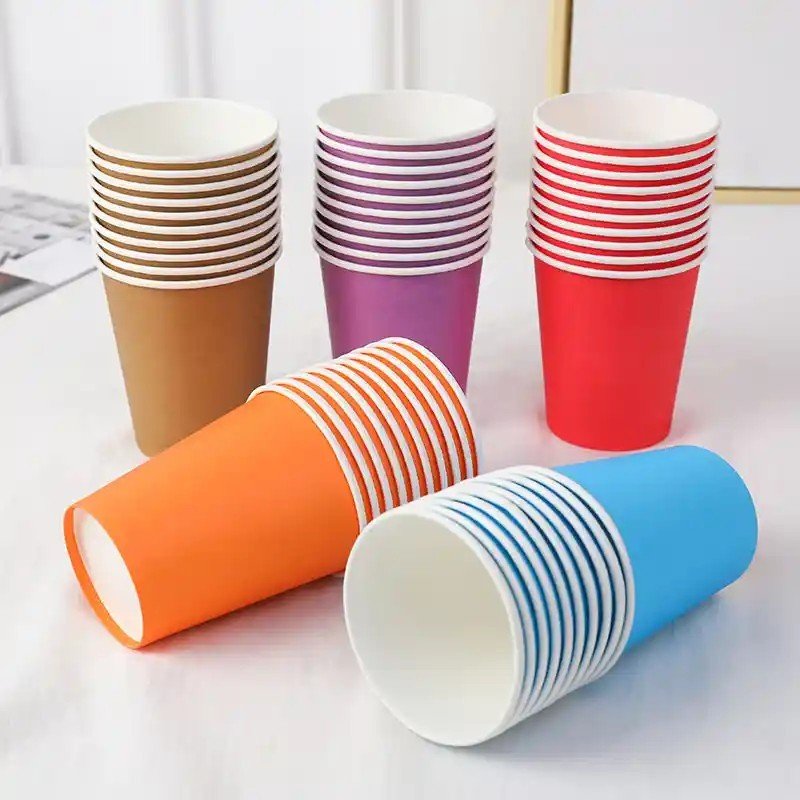
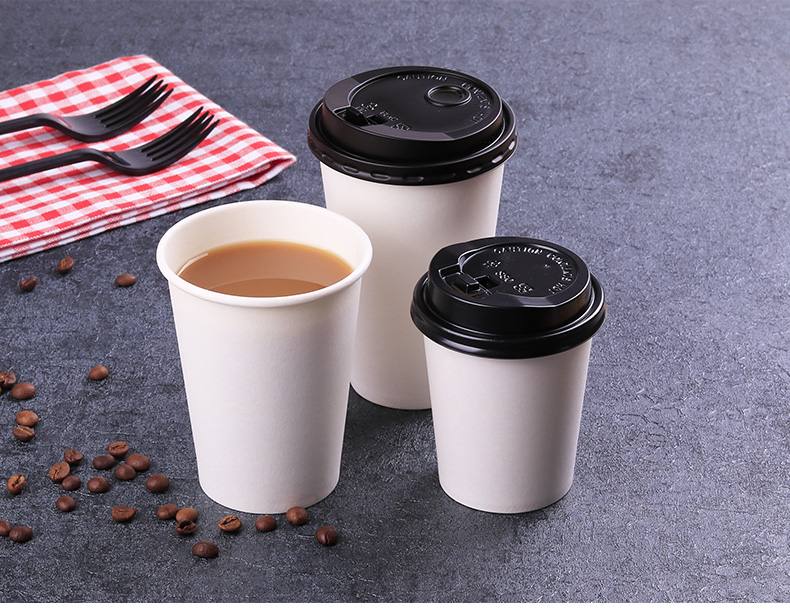
A paper cup looks simple; it isn’t. It’s a food-contact package that must hold boiling liquid, survive a lid pressed on at speed, stack thousands high without jamming, and carry your brand at the exact moment someone takes a sip. The two photos above cover our whole range: the first is the stock white cup family — six sizes sharing four rim diameters, the backbone of the 100-pc MOQ — and the second shows what printing adds: a repeating pattern that turns a commodity cup into brand media.
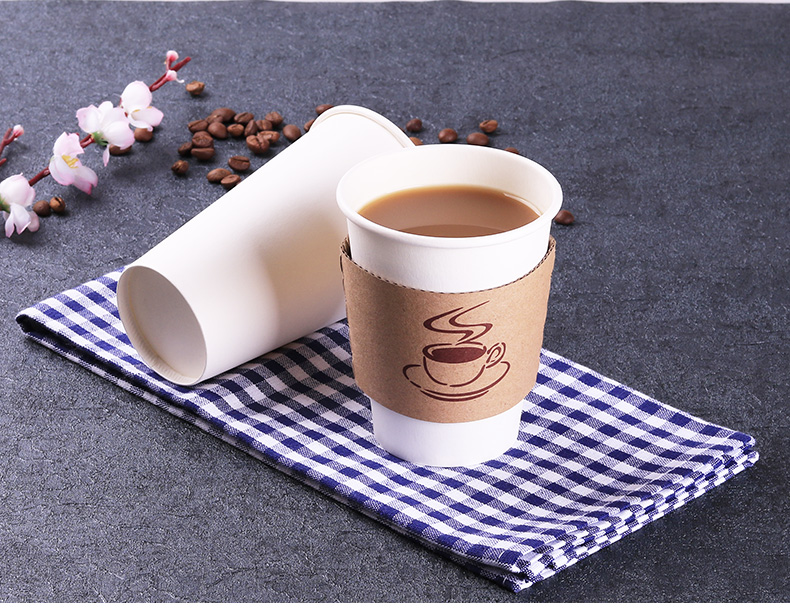
Everything on this page is food-contact compliant (FDA, EU 1935/2004), printed only on the outside with an ink-free rim zone where lips touch, and available with matched lids so nothing pops off in a customer’s hand.
Why MOQ 100 Works (And What It Buys You)
The honest math behind the lowest MOQ in the cup industry.
Cup factories normally quote 30,000–50,000 pcs per design because cups are printed on the flat paper before forming — flexo plates and machine setup cost the same whether you make 10,000 or 100,000 cups. Our 100-pc MOQ works because we split the flow:
Route A — Stock cups + digital print, 100 pcs up
Standard sizes run on existing molds; branding is applied by digital printing on finished cups. No plates, no setup — ideal for testing designs, events, cafés and offices. Lead time 7–10 days.
Route B — In-line flexo/offset print, 10,000+ pcs
Artwork printed on the paper reel before cup forming — the lowest unit cost and the crispest large-area print (like the stripe pattern in our photo). Plates are kept and reused, so repeat orders match perfectly.
The practical playbook: prove your design with 100 digital cups, then switch to in-line printing at 10,000+ — your artwork carries over unchanged, and the unit price typically drops by half or more. Plates are stored free, so seasonal reorders skip setup entirely.
Technical Specifications
| Specification | Detail |
|---|---|
| Material | Food-grade paperboard 170–350 gsm with PE / PLA / water-based dispersion lining |
| Sizes (stock) | 4 / 8 / 10 / 12 / 16 / 20 oz — rim diameters 60 / 70 / 80 / 90 mm |
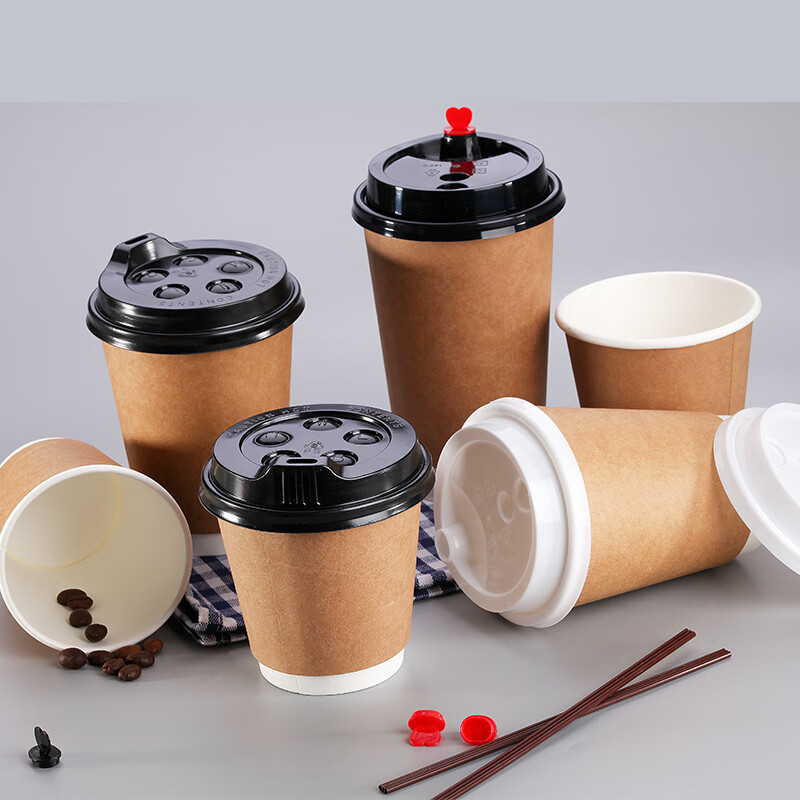
| Wall types | Single wall (cold & warm), double wall (hot, insulated air gap), ripple wall (corrugated wrap, best insulation & grip) |
| Use temperature | PE-lined: up to ~90 °C (hot grade); PLA-lined: cold only, below ~45 °C; water-based: hot & cold |
| Printing | Digital (100 pcs up, on finished cups); flexo 1–4 colors and offset (10,000+ pcs, in-line); ink-free rim 10–15 mm as standard |
| Inks | Food-contact-safe, exterior application only; interior unprinted white |
| Lids | PS / PP / PET (clear, cold) / CPLA (compostable); sip lids and stopper lids available; matched per rim diameter |
| Accessories | Kraft/white cardboard sleeves, stirrers, carry trays |
| Compliance | FDA 21 CFR, EU 1935/2004; certificates per shipment; EN 13432 for PLA/ compostable options |
| MOQ | 100 pcs (stock sizes, digital print); 10,000+ pcs per design for in-line flexo/offset printing |
| Lead time | 7–10 days digital; 12–18 days in-line print (incl. plates) |
| Packing | Nested in sleeves, 20–50 pcs/sleeve per carton; 20 ft container ≈ 300,000–500,000 cups (size-dependent) |
Size & Lid Guide
Six stock sizes, four rim diameters — and the inventory trick hidden in that overlap.
| Size | Rim Ø | Typical use | Lid shared with |
|---|---|---|---|
| 4 oz | 60 mm | Tasting, sauces, espresso doppio, dental | — |
| 8 oz | 70 / 80 mm | Espresso, small coffee, juice kids’ size | 10 oz (same rim) |
| 10 oz | 80 mm | Medium coffee, tea, cold brew | 8 oz (same rim) |
| 12 oz | 80 / 90 mm | Standard coffee size — the default café cup | 16 oz (same rim) |
| 16 oz | 90 mm | Large coffee, iced drinks, smoothies | 12 oz / 20 oz (same rim) |
| 20 oz | 90 mm | Extra-large, soft drinks, popcorn | 16 oz (same rim) |
How to choose your size
- Know your fill volume — an “8 oz cup” holds 8 oz to the brim; practical fill is ~90%, so order one size up if you serve a full 240 ml.
- Decide hot or cold first — this sets lining and wall type (next section).
- Check your cup dispenser and car cupholders — 90 mm cups don’t fit older dispensers; send us the model if unsure.
- Order blank samples of 2–3 sizes — free of charge; feel them, fill them, press lids on.
- Match lids within one rim family to minimize SKUs.

Wall Types & Insulation
The cup wall is the difference between “comfortable to hold” and “grab a sleeve or regret it.”
Single wall
One paper layer. Cheapest, lightest, ships smallest. Fine for cold drinks, water, warm drinks under ~70 °C. Hot coffee needs a sleeve. (Our white cup family photo is single wall.)
Double wall
Two layers with an insulating air gap — no sleeve needed for boiling drinks. The default for coffee shops; adds modest cost and bulk. Clean branding surface on the outer layer.
Ripple wall
Corrugated outer wrap: best insulation and grip, premium look and feel, hides condensation on iced drinks. Costs 20–30% over double wall; the vertical flutes make printed bands pop.
Our default recommendation: single wall for cold and takeaway water; double wall for anything above 85 °C; ripple for premium cafés and iced signature drinks.
Lining Options: PE vs PLA vs Water-based
The invisible layer that decides heat tolerance, end-of-life story and price.
| Lining | Heat tolerance | End of life | Cost | Choose when |
|---|---|---|---|---|
| PE (single or double coat) | Up to ~90 °C | Recyclable where poly-coated cups are accepted | $ | Default for hot drinks; proven, leak-proof, cheapest |
| PLA bioplastic | Cold only (<45 °C) | Industrially compostable (EN 13432) | $$ | Cold drinks + a real composting stream nearby; “plastic-free” marketing |
| Water-based dispersion | Hot & cold | Recyclable in standard paper streams | $$ | Hot drinks + strict single-use rules; the future-proof option |
Printing & Branding
From a one-color logo at 100 pcs to full-wrap patterns — with the rim rule always respected.

| Option | Volume | Colors | Best for |
|---|---|---|---|
| Digital on finished cups | 100 pcs up | Full color | Small batches, design testing, events, names/personalization |
| Flexo in-line | 10,000+ pcs | 1–4 spot colors | Logos and solid patterns (like the stripe design) at the lowest unit cost |
| Offset in-line | 30,000+ pcs | Full CMYK + spot | Photographic artwork, gradients, premium café programs |
| Full-wrap pattern | 10,000+ pcs | 1–4 colors | Repeating motifs that read from every angle — the highest brand recall per cup |
| Sleeve branding | 500 pcs up | Full color on kraft/white | Keeping cups white but branding the grip — cheapest way to add brand to hot drinks |
Design tip from the stripe cup: repeating diagonal patterns forgive flexo’s slight ink spread, cost one or two colors instead of four, and look intentional even when cups rotate — the highest brand value per printing dollar in this category.
How Paper Cups Are Made
Six steps from reel to sleeve — knowing them explains every spec on this page.
- Printing on the reel — artwork printed on flat food-grade paper (in-line routes); the ink-free rim is left blank here.
- Laminating — PE, PLA or water-based lining applied to the paper (double-coated for cold cups).
- Die-cutting — the fan-shaped cup blank and the round bottom disk are cut from the printed sheet.
- Side sealing — the blank is wrapped around a mandrel and the side seam is heat-sealed.
- Bottom forming & curling — the bottom disk is inserted and curled into the rim; the knurled rim curl you can feel on the lip is what makes lids snap on and stop drips.
- Inspection & packing — leak testing on samples per batch, nested into sleeves of 20–50.
Usage & Handling Rules
Five rules that prevent almost every cup complaint.
1. Match cup to temperature
Hot grade PE cups for anything above 70 °C; never PLA for hot; double or ripple wall above 85 °C — or add sleeves to single wall.
2. Press lids on a flat surface
Thumb around the whole rim until it clicks evenly. Half-pressed lids are the #1 cause of “it leaked in the car” complaints.
3. Store cups sealed and dry
Open cartons absorb moisture and cups lose stiffness; keep sleeves wrapped until use.
4. Don’t microwave lined cups
PE and PLA linings are not microwave-safe; transfer to a microwave-safe vessel.
5. Fill line awareness
Leave ~10% headspace for lids and steam, especially on hot drinks with foam.
Bonus: stack discipline
Keep cups in their nested sleeves until service — loose stacking deforms rims and causes lid failures later.
Applications
| Scenario | Recommended setup | Why |
|---|---|---|
| Café / coffee shop | 8/12/16 oz double wall, one rim family, flexo logo | No sleeves needed; one lid SKU; lowest in-line cost |
| Office & pantry | 8 oz single wall white, water cooler cups | Utility use — plain white keeps cost minimal |
| Events & catering | Digital print, any design, 100–5,000 pcs | Small volumes with full-color branding; design can change per event |
| Iced drinks / smoothie bars | 16/20 oz single wall PET-clear lid, PLA or PE | Condensation-friendly walls; clear lids show the product |
| Food sampling & tastings | 4 oz single wall, blank or 1-color | Tiny volumes, lowest cost per serve |
| QSR chains | In-line offset, full CMYK, ripple wall | Photo-quality branding at scale; premium grip |
Paper Cups vs Plastic Cups vs PLA Cups
The three disposable formats compared honestly.
| Dimension | Paper cup (this product) | Plastic cup (PP/PET) | PLA bioplastic cup |
|---|---|---|---|
| Hot drink suitability | Excellent (double/ripple wall) | PP only, scalds hands, deforms in grip | No — softens <45 °C |
| Clarity of contents | Opaque | Crystal clear shows the drink | Clear / hazy |
| Insulation & grip | Best (air gap / flutes) | Condensation, needs sleeve | Same as plastic |
| Branding surface | 360° print, wraps & patterns | Cup printing limited; often sleeve | Printable but hazy base |
| End of life | PE-lined: poly-coated stream; water-based: paper stream | Recyclable where collected | Industrial composting only |
| Perceived eco value | High — “paper” reads green | Low | High, if infrastructure exists |
| Unit cost | $$ | $ | $$$ |
| Best role | Hot drinks + brand-forward service | Cold drinks at volume | Cold drinks + composting streams |
OEM & Our Services
What you get beyond the cup.
| Service | What it means in practice |
|---|---|
| Free blank samples | Stock cups of candidate sizes shipped free — test lid fit and fill line before ordering |
| Artwork support | Dielines with the ink-free rim marked; print-ready file checks included |
| Two-route quoting | Every inquiry quoted both digital (100+) and in-line (10,000+) with the crossover point marked |
| Matched closures | Lids, sleeves, stirrers and trays from one source — guaranteed fit |
| Plate storage | Flexo/offset plates stored free; repeat orders print identically with no setup |
| Compliance files | FDA / EU 1935/2004 certificates per shipment; EN 13432 for compostable options |
| Mixed-SKU consolidation | Cups consolidated with your other JAJA packaging in one shipment |
JAJA Packing is a packaging supply-chain integrator based in Huzhou, China, working with 1,200+ audited factories — including specialist cup converters for foodservice and retail brands. One team handles your cups alongside lids, sleeves, bags and boxes, with consistent quality standards and consolidated shipping. Learn more about us, or browse related products: kraft paper bags, paper gift boxes, roll labels & stickers.
Frequently Asked Questions
How can your MOQ be 100 pcs when most cup factories ask for 30,000+?
Standard cup sizes (4–20 oz) run on existing molds on high-speed lines, so there is no tooling cost. For branding at 100 pcs we print on stock white cups using digital printing — economical at tiny volumes. Full in-line flexo/offset printing (printed before cup forming) carries plate and setup cost, which is why that route starts at higher volumes (typically 10,000+ pcs per design). We quote both routes so you can choose.
What is the difference between hot cups and cold cups?
Cold cups use PE lining plus an outer coating to resist condensation, and thinner paper. Hot cups use a single inner PE lining with thicker paperboard (250–350 gsm), and insulation comes from double wall or ripple wall construction. A cold cup used for boiling coffee feels scalding and can leak at the bottom seam; a hot-grade cup works for both. Tell us the drink temperature and we specify correctly.
Is the ink food-safe? What is an ink-free rim?
All printing is applied only on the outside of the cup with food-contact-safe inks, and we keep an ink-free rim zone of 10–15 mm below the lip — the area where lips touch — so no printed ink ever contacts the mouth. Interior surfaces stay unprinted white. This matches EU 1935/2004 and FDA food-contact requirements, and certificates are available per shipment.
Are the cups compostable or recyclable?
Three lining options: standard PE lining (recyclable where poly-coated cups are accepted; cheapest), PLA bioplastic lining (industrially compostable per EN 13432, cold drinks only), and water-based dispersion lining (recyclable in standard paper streams, newest option, small price premium). We recommend matching the lining to your local waste infrastructure rather than paying for compostability no one can process.
What sizes are available?
Stock sizes run 4, 8, 10, 12, 16 and 20 oz with matching rim diameters of 60, 70, 80 and 90 mm. Lids are matched per rim diameter, so an 8 oz and a 12 oz with the same 80 mm rim share one lid SKU — useful for simplifying your inventory.
Which wall type should I choose — single, double or ripple?
Single wall: cheapest, needs a sleeve for very hot drinks — fine for cold drinks and warm beverages. Double wall: an insulated air gap built in, no sleeve needed — the standard for coffee shops. Ripple wall: corrugated outer wrap with the best grip, insulation and a premium look, about 20–30% more than double wall. We suggest double wall as the default for hot beverages above 85 °C.
What are the lead times?
Stock white cups with digital printing: 7–10 days. In-line flexo/offset printed cups: 12–18 days including plate making. Lids and sleeves ship with the same order. Cups ship nested — a 20 ft container holds roughly 300,000–500,000 cups depending on size.
Can I get samples before ordering 100 pcs?
Yes. We send blank stock cups of the candidate sizes free of charge so you can test lid fit, feel and fill line — you only cover shipping. Digital-printed orders receive flat artwork proofs, and a printed photo sample before mass production.
Do you supply matching lids and accessories?
Yes — PS, PP, PET (clear, cold) and CPLA (compostable) lids in all stock rim diameters, plus kraft and white cardboard sleeves, stirrers and carry trays. Ordering cups and lids from one source guarantees the fit; mixed sources are the most common cause of lid pop-offs.