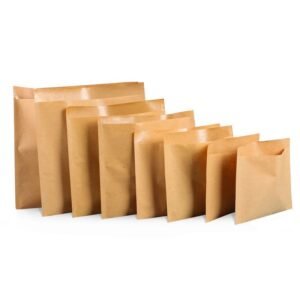


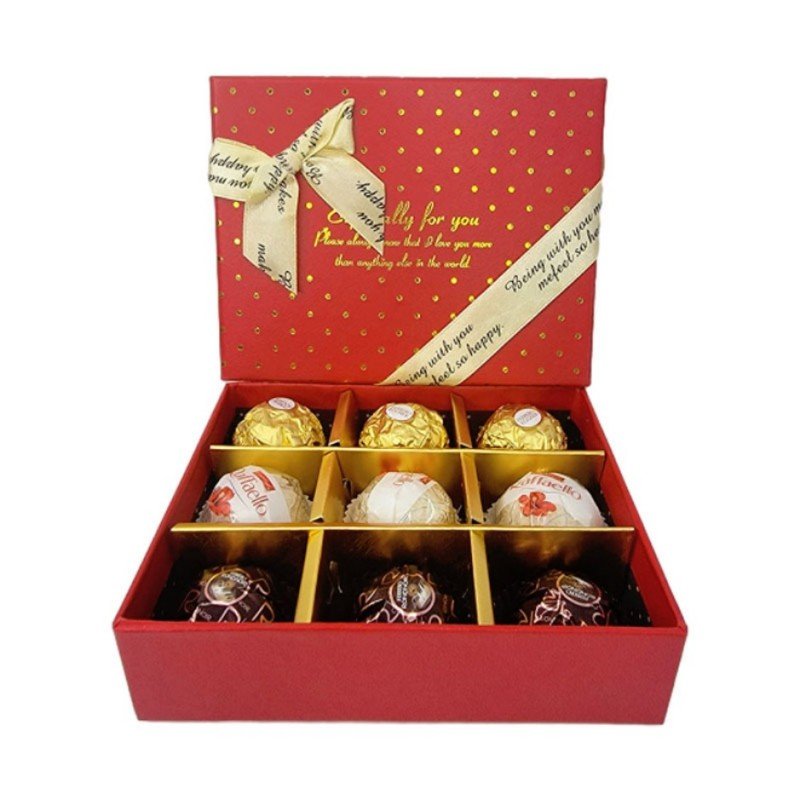

Product Description
These are custom-built chocolate paper boxes — paperboard packaging manufactured to your specifications rather than sold from a fixed catalogue. You give us the product dimensions (or a sample), the piece count, the structure you like and your brand colours; we produce the die-line, the printed proof, a physical sample, and then the full run. Available as folding cartons for retail bars, rigid setup boxes for premium assortments, drawer and window boxes for gifting, and shaped boxes for seasonal launches.
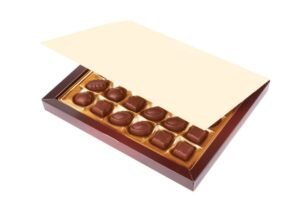
Chocolate is an unforgiving product to pack. It melts near body temperature, it blooms if temperature cycles, shells crack if pieces rattle, and cocoa butter wicks through unprotected paper and leaves stains on the outside of the box. A good chocolate box therefore does three jobs at once: it holds each piece immobile (that is the insert’s job), it presents the brand on shelf (that is the print and finish), and it keeps the chocolate isolated from the board (that is the barrier or wrapping). We engineer all three.
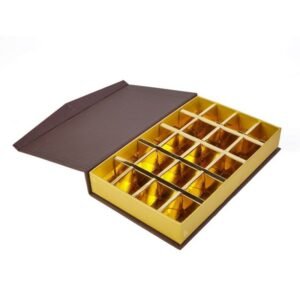
Every box is specified individually. Board grade is selected by weight and rigidity — 250–400 gsm folding carton stock for lightweight retail packs, 1.5–3 mm greyboard wrapped in printed art or specialty paper for rigid gift boxes. Inserts are cut to your exact cavity layout, in food-grade PET, plastic-free moulded pulp, paperboard or EVA. Colour is matched to Pantone references with spot inks, or printed in CMYK for photographic artwork. Finishing options run from matte or gloss lamination to hot foil stamping, embossing, debossing and spot UV.
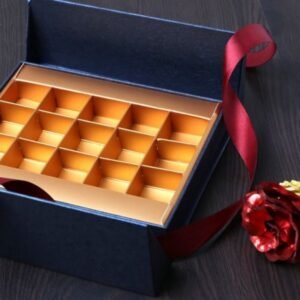
All board is available FSC-certified on request, and we supply FDA, LFGB, REACH and RoHS documentation for the materials used. Where chocolate contacts packaging directly, we specify virgin fibre board and a food-grade barrier liner rather than recycled board, because recycled fibre can carry mineral oil residues (MOSH/MOAH) that migrate into fat-rich products like chocolate.
Key Features Explained
- True custom sizing — boxes are cut to a die-line built from your product, not adapted from a stock size. No rattling, no wasted shelf volume, no oversized freight.
- Exact colour control — Pantone spot inks for brand-critical colours including metallics and pastels outside the CMYK gamut; one or two spot colours can be combined with CMYK for the best cost-to-impact ratio.
- Inserts that actually hold — vacuum-formed trays with precise cavity walls, or plastic-free pulp and paperboard equivalents, so pieces arrive uncracked and unscuffed.
- Grease management — barrier liners, foil wrapping or greaseproof interleaving prevent cocoa butter migration and the oil staining that ruins an otherwise premium box.
- Finishes that sell — soft-touch lamination and foil stamping are the two finishes that most reliably lift perceived value in confectionery; we will tell you honestly which are worth the cost at your price point.
- Flat-pack economics — folding cartons ship flat and assemble in seconds at your packing line, keeping unit freight cost low even on long-distance export orders.

Full Specifications
| Parameter | Specification |
|---|---|
| Product name | Custom chocolate paper box (folding carton / rigid box / drawer box / window box) |
| Box structures | Tuck-end carton, auto-lock bottom carton, rigid lid-and-base, drawer (slider), book-style magnetic, pillow, hexagon, heart, window box |
| Folding carton board | 250 / 300 / 350 / 400 gsm C1S or C2S art paper, kraft board, or specialty textured paper |
| Rigid box board | 1.5 / 2.0 / 2.5 / 3.0 mm greyboard, wrapped in 128–157 gsm printed art paper or specialty paper |
| Paper options | Coated art paper, natural kraft, black/white card, metallic paper, textured and embossed specialty papers, FSC-certified stock |
| Size range | Fully custom — typical range 60 × 60 × 25 mm up to 400 × 300 × 80 mm |
| Printing | CMYK offset litho; Pantone (PMS) spot colours up to 6; inside and outside printing available |
| Surface finishes | Matte or gloss lamination, soft-touch, aqueous coating, spot UV, hot foil (gold / silver / rose gold / coloured), emboss, deboss |
| Insert trays | Vacuum-formed PET / PVC / PS; moulded paper pulp; paperboard cavity or divider; EVA foam wrapped in velvet or paper |
| Food-contact barrier | Food-grade PET tray, glassine or greaseproof liner, foil wrap; virgin fibre board for direct-contact designs |
| Window | Clear PET or OPP panel (see our food-grade OPP film), any shape, with or without print border |
| Closures | Tuck flap, auto-lock bottom, ribbon tie, magnetic catch, drawer pull, lift-off lid, sleeve-and-tray |
| Colour matching | Pantone spot ink matching with printed proof; CMYK with G7-calibrated proofing |
| Artwork required | AI / PDF / EPS vector, outlined fonts, 3 mm bleed, 300 dpi images; die-line template supplied by us |
| Certifications | FSC (on request), FDA, LFGB, REACH, RoHS, ISO, BSCI-assessed partner factories |
| MOQ | From 500 pcs for printed folding cartons; 500–1,000 pcs for rigid boxes with custom inserts; lower for plain stock |
| Sample | Plain sample 2–3 days; printed custom sample 5–7 days; sample fee credited against bulk order |
| Lead time | 10–15 days folding cartons; 15–25 days rigid boxes, after sample approval |
| Packing | Flat-packed for folding cartons; rigid boxes nested or individually sleeved; export carton to your spec |
| Shipping | EXW / FOB Shanghai or Ningbo; worldwide air and sea freight arranged |
Box Structures — Which One Fits Your Product
Choosing the structure is the first decision, because it sets your unit cost, your shelf presence and your freight volume. Here is how the main options compare in practice:
| Structure | Best for | Feel on shelf | Relative cost |
|---|---|---|---|
| Tuck-end folding carton | Chocolate bars, retail multipacks, everyday SKUs | Clean, efficient, full print area | Lowest |
| Auto-lock bottom carton | Heavier assortments, 250 g+ boxes | Same as carton, much stronger base | Low |
| Rigid lid-and-base | Premium truffle and praline gift boxes | Heaviest, most luxurious unboxing | Highest |
| Drawer (slider) box | Gift assortments, seasonal launches | Reveal moment, ribbon pull | Medium-high |
| Book-style magnetic | Corporate gifting, flagship SKUs | Opens like a book, stays closed | High |
| Window box | Products that sell on appearance | Shows the chocolate inside | Low-medium |
| Sleeve and tray | Recyclable ranges, minimal-plastic lines | Minimal, modern, plastic-free | Medium |
| Shaped (heart, hexagon, pillow) | Valentine’s, Christmas, promotions | Seasonal standout | Medium-high (tooling) |
Size & Capacity Guide
These are the dimensions we are asked for most often. Every one of them is a starting point — we cut the die-line to your actual product dimensions, not the other way around.
| Format | Typical inner size (L × W × H) | Capacity | Suggested board |
|---|---|---|---|
| Single bar sleeve / carton | 150 × 55 × 20 mm | 1 bar, 40–100 g | 300 gsm folding carton |
| Bar multipack carton | 160 × 110 × 35 mm | 3–5 bars | 350 gsm folding carton |
| Small truffle box | 110 × 110 × 35 mm | 4 pieces | 350 gsm carton or 1.5 mm rigid |
| Standard assortment | 160 × 110 × 35 mm | 6–9 pieces | 2.0 mm rigid + insert tray |
| Classic gift box | 200 × 200 × 40 mm | 12–16 pieces | 2.5 mm rigid + PET or pulp tray |
| Large gift chest | 300 × 220 × 50 mm | 24–30 pieces | 3.0 mm rigid + tray |
| Advent / calendar box | 320 × 240 × 45 mm | 24–25 doors | 2.5 mm rigid + divider |
| Corporate presentation box | 350 × 250 × 60 mm | Mixed assortment | 3.0 mm rigid + EVA or paperboard |
How to Measure Your Product
- Measure the longest chocolate piece at its widest point, including any foil wrap.
- Add 1–2 mm clearance per side for the cavity — enough to lift pieces out, not enough to rattle.
- Add board thickness × 2 to get the outer dimension (critical for shelf and shipper fit).
- Add 3–5 mm headroom above the tallest piece so the lid never presses on the chocolate.
- Send us the numbers, or simply send a sample — we measure and produce the die-line for you.

What You Can Customize
Short answer: everything that is visible or measurable. Here is the full menu, with the practical notes that matter when you are specifying an order.
| Element | Options | Notes |
|---|---|---|
| Size | Any dimension, any proportion | Die-line built from your product; no tooling charge on standard shapes |
| Colour | Pantone spot inks, CMYK, or both | Pantone for exact brand match and metallics; CMYK for photography |
| Shape | Rectangle, square, heart, hexagon, pillow, book, custom die-cut | Custom shapes need a cutting die — one-off charge, reusable on reorders |
| Board | 250–400 gsm folding; 1.5–3 mm rigid; kraft, art, black, metallic, textured | Heavier board for larger boxes and heavier contents |
| Insert tray | PET / PVC / PS vacuum-formed; paper pulp; paperboard cavity; EVA | Cavity count and layout fully custom: 4, 6, 9, 12, 16, 24 or any number |
| Print finish | Matte, gloss, soft-touch lamination; aqueous; spot UV | Soft-touch is the strongest perceived-value finish in confectionery |
| Foil & texture | Hot foil gold / silver / rose gold / coloured; emboss; deboss | Foil plus emboss on a logo is the classic premium combination |
| Window | Clear PET or OPP panel, any shape, with or without border | Budget reminder: windows reduce recyclability slightly and add a cent or two |
| Closure | Tuck flap, ribbon, magnet, drawer pull, lift-off lid, belly band | Magnets add weight and cost; ribbons add hand-assembly time |
| Inside print | Full-colour inside, brand message, ingredient panel, story copy | Inside print is a low-cost way to add real perceived value |
| Barrier | Greaseproof liner, glassine, foil wrap, food-grade PET tray | Recommended for any direct-contact or high-cocoa-butter product |
| Sustainability | FSC board, plastic-free pulp insert, aqueous coating instead of lamination | Tell us your target and we will spec the most recyclable construction |
How the Box Is Made — And How to Pack It Right
From brief to shipment
- Send the product spec — dimensions, piece count, weight, photos or a physical sample.
- Choose the structure — folding carton, rigid, drawer, window or shaped, with our recommendation on cost and protection.
- We issue the die-line — a vector template of the exact cutting shape for your artwork team.
- Artwork goes on the die-line — your design, or ours: our designers rebuild it free from a sketch or reference box.
- Proof and colour check — digital proof plus a physical printed sample on the actual board, for Pantone approval.
- Sample approval — you assemble your chocolate in it and confirm the fit before any tooling for volume.
- Printing — offset litho in CMYK and/or Pantone, on the selected board.
- Finishing — lamination, foil, emboss, spot UV, then die-cutting and creasing.
- Insert production — trays vacuum-formed or moulded to the approved cavity layout.
- Assembly and QC — gluing, magnet or ribbon fitting, then piece-by-piece inspection and count.
- Packing — flat-packed or nested into export cartons, with drop-test-verified packing specs.
- Shipment — FOB Shanghai or Ningbo, or door-to-door air and sea freight arranged to your port.
Packing chocolate correctly
- Cool the chocolate fully before packing — warm pieces sweat inside the box and bloom on the surface.
- Wrap or barrier first — foil, glassine or a food-grade tray liner; never let bare chocolate sit on printed board.
- Seat each piece in its cavity without forcing — pressure cracks shells and scuffs tempered surfaces.
- Leave headroom below the lid so nothing is compressed in transit.
- Close and check the closure — tuck flaps fully seated, magnets aligned, ribbons tied consistently.
- Store at 12–20 °C with humidity below 55% — cocoa butter softens around 28 °C and sugar blooms above 60% RH.
- Use an insulated shipper for warm-climate or summer deliveries; the box protects the chocolate, not the climate.
Applications & Fit
| Chocolate type | Recommended structure | Fit rating |
|---|---|---|
| Chocolate bars (40–100 g) | Tuck-end folding carton or sleeve | Excellent |
| Truffles & pralines | Rigid box or drawer box with cavity tray | Excellent |
| Assorted gift assortments | Rigid lid-and-base, 12–30 pieces | Excellent |
| Chocolate-covered nuts / fruits | Window carton with greaseproof liner | Excellent |
| Seasonal shapes (hearts, Santa, eggs) | Shaped carton or rigid box | Very good |
| Chocolate spread or cocoa powder jars | Carton with paperboard divider | Very good (weight check required) |
| Filled chocolates with liquid centres | Rigid box with tight PET tray | Good (needs secure cavity) |
| Frozen or chilled chocolate desserts | Not recommended without moisture-resistant board | Use coated board or plastic alternative |
Paper Box vs. Pouch vs. Tin for Chocolate
Each format wins in different channels. If you are deciding what to put a new SKU in, this is the trade-off table:
| Dimension | Custom Paper Box (this product) | Stand-Up Pouch | Metal Tin |
|---|---|---|---|
| Shelf presence / gifting | Highest — rigid structure reads as a gift | Casual, snack-oriented | High, but dated in some markets |
| Piece protection | Insert tray locks every piece | Pieces move and rub | Good, but needs padding |
| Print area & finishes | Full wrap + foil, emboss, soft-touch | Good print, fewer finishes | Limited, usually litho on metal |
| Unit cost | Medium (US$0.15–2.50) | Lowest | Highest |
| Freight efficiency | Flat-packs for cartons | Flat, very efficient | Ships assembled, bulky |
| Moisture barrier | Needs liner or lamination | Excellent film barrier | Excellent |
| Recyclability | Paper stream, plastic-free options | Mono-material PP or PE where available | Metal stream, widely recycled |
| Custom shape freedom | Heart, hexagon, book, any die-cut | Limited to pouch shapes | Limited by tooling cost |
| MOQ & tooling | From 500 pcs, low tooling | From 500 pcs, plate cost only | High tooling, larger MOQs |
| Best channel | Gift, retail, corporate, seasonal | E-commerce refills, snacks, bulk | Premium keepsake, long shelf life |
Frequently Asked Questions
What types of chocolate boxes can you make?
We produce the full range: folding cartons with tuck-end or auto-lock bottoms for chocolate bars and retail packs; rigid setup boxes with lift-off lid for premium assortments; drawer (slider) boxes with ribbon pull; window boxes with a PET or OPP film panel; and shaped boxes (heart, hexagon, pillow, book-style). Closures, inserts, ribbons and print finishes are all specified per order.
Can the chocolate touch the box directly?
We recommend a food-grade barrier between chocolate and board. Printed outer surfaces and recycled fibres are not intended for direct food contact, and cocoa butter can wick through paper over time, leaving oil stains on the outside. Standard practice is to wrap pieces in foil or food-grade paper, or to use a food-grade PET, glassine or greaseproof insert tray. If you want direct contact, specify virgin fibre board plus a food-contact liner and we will supply the matching compliance documents.
Can you match my brand colour exactly?
Yes. Send the Pantone (PMS) reference and we print with spot Pantone inks for an exact match, including metallics and pastels that CMYK cannot reproduce. CMYK offset printing is the more economical option for photographic artwork; a common approach is CMYK for the image plus one or two Pantone spot colours for brand-critical elements. We provide a printed proof or a physical sample before mass production.
What insert trays do you offer?
Four families: vacuum-formed PET, PVC or PS trays (crystal clear, precise cavities, the choice for premium pralines); moulded paper pulp trays (plastic-free and recyclable); paperboard cavity inserts or dividers (lowest cost, fully paper); and EVA or foam padding wrapped in velvet or paper for gift presentation. Cavity layouts are cut to your exact piece count and dimensions — 4, 6, 9, 12, 16, 24 or any custom arrangement.
What is the MOQ and lead time?
MOQ is typically 500 pcs for printed folding cartons and 500–1,000 pcs for rigid boxes with custom inserts, depending on size and finish; plain stock boxes can start lower. Lead time is 10–15 days for folding cartons and 15–25 days for rigid boxes after sample approval, plus shipping. Samples take 5–7 days. Contact WhatsApp +86 131 2388 3167 or sales1@jajapacking.com for a quote within 24 hours.
Do you ship the boxes flat to save freight?
Folding cartons ship flat-packed — roughly 60–80 boxes per carton depending on size — which keeps air and sea freight economical and saves warehouse space. Rigid setup boxes are three-dimensional and ship assembled, so we quote on volume; where possible we design collapsible rigid bases or nest lids to reduce cube. We advise on the most cost-efficient construction for your shipping method before tooling.
Are the boxes recyclable or plastic-free?
Paperboard boxes are recyclable in standard paper streams and we can supply FSC-certified board on request. To go fully plastic-free, choose a pulp or paperboard insert instead of PET and skip film lamination in favour of aqueous or varnish coating. Note that foil stamping, soft-touch lamination and PET windows reduce recyclability, so we help you balance shelf impact against your sustainability commitments.
What artwork files do you need?
Vector files are best — AI, PDF or EPS with outlined fonts, CMYK or Pantone colours defined, 3 mm bleed and 300 dpi images. We issue a die-line template for your exact box dimensions so the artwork is laid out on the true cutting shape. If you only have a sketch or a photo of an existing box, our design team rebuilds the structure and produces print-ready artwork at no extra charge.
Will the box protect chocolate during shipping?
Structure matters more than board weight. A snug insert that locks each piece in place prevents the rattling that cracks shells and scuffs temper, and a rigid or corrugated shipper protects the retail box in transit. For warm-climate destinations we recommend insulated shippers or cold-chain packing; chocolate above roughly 28 °C softens and blooms regardless of how strong the box is.
OEM & Our Services
JAJA Packing is a professional OEM & ODM packaging service provider — a packaging supply chain integrator and exporter with a network of over 1,200 partner factories, 20+ product categories and 20,000+ packaging designs. We manage the entire process: supplier screening, price comparison, prototyping, quality control, delivery scheduling and final export. Chocolate boxes are one of our strongest categories because they combine structural design, print finishing and food-contact compliance — three things buyers rarely want to source from three different suppliers.
| Service Item | Details |
|---|---|
| Customization scope | Size, shape, board grade, Pantone colour, insert tray, window, closure, print finish — all made to order |
| Design support | Free die-line, structural design and artwork adaptation; physical sample before mass production |
| MOQ | Low MOQs — printed folding cartons from 500 pcs; rigid boxes from 500–1,000 pcs |
| Quote speed | Quote within 24 hours of receiving specifications |
| Compliance support | FDA, LFGB, REACH, RoHS, CE, ISO certificates and test reports assisted; FSC board on request |
| Factory audits | On-site factory inspections and virtual audits welcome |
| After-sales | Any questions or claims answered within 24 hours |
| Payment & shipping | Flexible terms; loading from Shanghai or Ningbo ports; worldwide export |