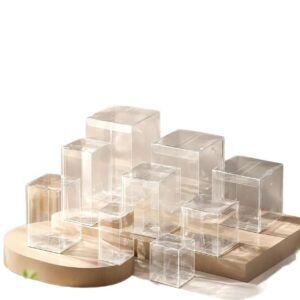


What Are Custom Produce Containers?
Custom produce containers are thin-wall clear plastic packages made by thermoforming — a heated food-grade PET/rPET sheet is vacuum- and pressure-formed over a mould, trimmed, and (for clamshells) hinged while still warm. The two dominant formats are the hinged clamshell (a container and lid in one folded piece, the standard for berries, cherry tomatoes, grapes and salads at retail) and the round or deli bowl with a snap-on lid (the standard for cut fruit, salad bowls and ready-to-eat mixes). Both are engineered around one physical fact: fresh produce continues to respire after harvest, releasing water vapour and heat inside a sealed clear box.

That is why a serious produce container is not “just a plastic box”. Its vent pattern decides whether leafy salad stays crisp or wilts, its anti-fog lid decides whether the customer sees strawberries or sees condensation, and its fluted rim decides whether the top container crushes the berries beneath it on the shelf. We handle all three as engineering inputs, customised to your product — not as afterthoughts. Customisation covers footprint, depth, compartment layouts, vent patterns, lid style and up to three printed colours, with a 1,000-piece first order.

Two Formats, Two Jobs
Hinged Clamshells
Job: protect fragile, high-value fruit through retail handling. One piece folds shut — no lid to separate, no mismatch in the packing line. Fluted rims create a stack load path around the product chamber; hinged design speeds packing to 2–3 seconds per punnet.
Best for: berries, cherry tomatoes, grapes, figs, cherries, salad leaves, mushrooms, baked goods. 100 g – 1,000 g formats.
Bowls & Deli Containers with Lids
Job: hold volume, show layers, survive a takeaway bag. Round bowls with domed lids give headroom for toppings and dressings; the lid snaps with an audible click so staff trust the seal. Straight-wall deli versions nest densely for foodservice.
Best for: cut fruit, salad bowls, meal-prep, olives and antipasti, snack cups. 250 – 1,500 ml formats.

The Hard Part: Breathing, Fog & Condensation
Produce keeps respiring after packing. It takes in oxygen, releases CO₂ and water vapour, and the vapour condenses on the coldest surface in the box — the lid, especially in a chiller. Three engineering levers control the result:
| Lever | What it does | When to use it |
|---|---|---|
| Anti-fog lid treatment | Food-grade coating makes condensate spread into a transparent film instead of light-scattering droplets | Cold-chain and high-moisture items: cut salad, berries, cut fruit, mushrooms |
| Ventilation holes | Releases respiratory heat and excess moisture; cools the pack contents faster after pre-cooling | Whole fruit with skin: tomatoes, apples, citrus, grapes in bunches |
| Near-sealed + anti-fog | Retains the humidity that leaves and berries need to stay turgid; anti-fog keeps the view clear | Cut salads, leafy mixes, delicate berries — the counter-intuitive one |
Material Selection
| Material | Clarity | Temp range | Recycling | Best for |
|---|---|---|---|---|
| APET ( virgin PET ) | Excellent — glass-clear | −20 to 60 °C | Code 1, kerbside | The produce standard; best optics and stiffness |
| rPET (recycled PET) | Excellent | −20 to 60 °C | Code 1 | Same performance + recycled-content claims for EU retailers and plastic taxes |
| PP | Good (slight haze) | −20 to 110 °C | Code 5 | Microwave or hot-fill applications; softer, cheaper |
| PLA (biobased) | Good | < 45 °C only | Industrial compost only | Only where industrial composting exists — see warning |
Size Guide — Standard & Custom
| Format | Typical size | Fill | Typical products |
|---|---|---|---|
| Berry punnet clamshell | 105×75×45 mm | 100–150 g | Blueberries, raspberries, cherries |
| Standard clamshell | 145×100×60 mm | 250–350 g | Strawberries, cherry tomatoes, figs |
| Large clamshell | 190×130×80 mm | 500–1,000 g | Grapes, salad mixes, mushrooms |
| Salad bowl + dome lid | Ø150–185 mm | 350–750 ml | Cut fruit, salad bowls, acai |
| Deli container | Ø120–150 mm | 250–1,000 ml | Meal prep, antipasti, snack cups |
| Custom footprint | Your spec | — | Send internal L×W×D + fill weight; we propose a mould-adapted size |
Three dimensions to send us: ① internal footprint and depth (or your target fill weight), ② the chiller/shelf height it must stack within (including the lid dome), ③ the product — because vent and anti-fog spec follow the product, not the shape. A mould-adapted custom size on a 1,000-piece first order is usually cheaper than buyers expect; a completely new forming mould is quoted openly with lead time.
Stacking & Crush Engineering
- The fluted rim is the load path. The zigzag ribs around the lid (visible in your stacked containers) raise stacking load onto the rib peaks and around the product chamber — soft berries survive the weight of a full display stack
- We load-test, not guess: packed containers stacked to your display height, held 24 hours at chilled temperature — the condition that actually weakens thin-wall PET
- Deeper punnet beats thicker wall for very soft fruit: volume around the fruit, not more plastic under it
- Chilled display matters: PET loses stiffness as temperature rises — a stack that survives at 20 °C can fail in a warm market stall; tell us your real display conditions
- Interlocking lid dimples (standard on our clamshells) stop columns sliding sideways in transport — the second cause of crushed fruit after over-stacking

Printing Your Logo on a Clear Container
| Method | Colours | Look | Cost | Best for |
|---|---|---|---|---|
| Dry offset on film | 1–3 | Crisp logo/text on the wall before forming | Most economical at volume | The produce standard — brand + PLU + barcode zone |
| IML (in-mould label) | Full colour | Photographic label fused into the wall | Higher | Premium ranges, brand storytelling |
| Roll labels (supplied by us) | Full colour | Applied by you or your packer | Low commitment | Startups, frequent artwork changes — pair with our roll labels |
| Embossed / engraved logo | — | Moulded relief, permanent, premium-subtle | One-time mould note | Zero-ink branding that never wears off |
| Printed lid / tamper band | 1–2 | Brand on the lid, seal cue on the tab | Low | Takeaway salad bowls — brand faces up in the chiller |
How Your Containers Are Made — 7 Steps
- Spec & product review — product, fill weight, storage temp, display stack; vent and anti-fog decisions made here
- Mould adaptation — existing cavity adapted to your footprint/depth, or new forming tool quoted; mould is yours, stored free
- Sheet extrusion — food-grade APET/rPET sheet extruded to gauge (0.25–0.6 mm typical); rPET content documented
- Printing (optional) — dry offset on the sheet before forming; colour sample signed off first
- Thermoforming — sheet heated, vacuum + pressure formed, plug-assist for even wall distribution
- Trimming & stacking — clamshells fold-hinged warm; bowls and lids trimmed, nested and counted
- QC & packing — wall-thickness check, lid snap-force check, stack load test per batch; nested packing for freight efficiency

Typical Applications
| Use case | Recommended spec | Why |
|---|---|---|
| Berries & cherries retail | Clamshell, anti-fog lid, near-sealed, fluted rim | Humidity retention + fog-free view + stack protection |
| Cherry tomatoes / grapes | Clamshell with 4–8 vents, printed brand | Whole fruit needs heat and moisture release |
| Cut fruit & salad bowls takeaway | Bowl + domed anti-fog lid, printed lid | Headroom, cold-chain clarity, brand faces up |
| Meal prep / foodservice | Deli containers + lids, PP if microwave | Nesting density, microwave option, low cost |
| EU retail programmes | rPET with recycled-content documentation | Plastic taxes, retailer scorecards, code-1 stream |
| Market stall / ambient | Vented clamshell, standard APET | No chiller — vents do the cooling work |
Clear PET Container vs CPET Tray vs Flexible Film Bag
| Dimension | Clear PET container | Printed film bag | Rigid CPET / injected tray |
|---|---|---|---|
| Unit cost | Low–medium | Lowest | High |
| Product visibility | 360° glass-clear | Good (clear film) | None (opaque) |
| Stack / crush protection | Good (engineered rims) | Poor | Excellent |
| Humidity & fog control | Anti-fog + vent engineering | Limited | N/A |
| Sealing / leak resistance | Snap lid; film seal possible | Heat-sealable | Film-sealable lidding |
| Custom tooling cost | Low (thermoform) | Low | High (injection) |
| Recycling stream | Code 1, kerbside | Code 4 / film stream | Code 1 / mixed |
| Best role | Retail produce where appearance sells | Hardy whole produce, volume lines | Ready meals, oven-ready formats |
Portfolio logic: fragile, appearance-driven produce earns the clear rigid container — the margin on premium berries pays for the packaging many times over. Hardy whole produce (potatoes, onions, citrus) runs fine in printed film bags at a fraction of the cost (see our printed plastic bags). Keep injection trays for oven-ready meal formats. Matching package class to product margin is the biggest cost lever in produce retail.
Frequently Asked Questions
What is the MOQ for custom produce containers?
MOQ is 1,000 pcs per size. Thermoforming tooling is far cheaper than injection moulds, and for most clamshell and bowl formats we adapt an existing mould cavity to your required footprint, depth and vent pattern, keeping a 1,000-piece first order economical. Fully custom shapes needing a new forming mould are quoted separately; the mould is yours and we store it free for repeat orders.
Will the lid fog up and hide my product?
Fogging is condensation: produce keeps breathing and releasing moisture after packing, and the vapour condenses on the coldest surface — the lid. We solve it with anti-fog treatment (a food-grade coating that turns condensate into an invisible film instead of droplets) and/or engineered ventilation. Cold-chain, high-moisture items like cut salad and berries should always specify anti-fog lids; we recommend a packed sample trial in your real chiller before mass production.
Do the containers need ventilation holes?
It depends on the product. Whole fruit with skin (tomatoes, apples, grape bunches) benefits from a few vents to release respiratory heat and moisture. High-moisture cut items (salad, berries) do better nearly sealed with an anti-fog lid, because every hole loses humidity the product needs to stay crisp. Tell us the product and storage temperature and we spec the vent pattern — the single most consequential decision on the box.
Are the containers food-safe and recyclable?
Yes. We use food-grade APET and rPET compliant with EU 10/2011 and FDA food-contact requirements; PP is available for microwave or hot-fill applications. Clear PET is the most widely recycled plastic (code 1) — our rPET option supports recycled-content claims now required by EU plastic taxes and retailer scorecards, with documentation supplied.
Can I print my logo on a clear container?
Yes — four ways: dry offset on the film before forming (1–3 colours, most economical at volume), IML for photographic quality, roll labels supplied by us, or an embossed logo in the mould (zero ink, permanent). All printing on clear material needs white ink backing for colour accuracy, and we always produce a physical printed sample first — colour on clear plastic differs from paper proofs.
What sizes and shapes are available?
Stock range: clamshells from 100 g berry punnets to 1 kg tomato formats, salad bowls from 250 ml to 1,500 ml with matching snap-on lids, and deli containers. Any custom footprint, depth or compartment layout is possible via thermoforming. Send internal dimensions, target fill weight and the shelf height it must stack in, and we propose a size and quote the same day.
How do I prevent berries from getting crushed in stacking?
Crush resistance is designed in: the fluted rim on our clamshells is not decoration — it raises the stack load path off the product chamber. We verify with a real load test: packed containers stacked to your display height for 24 hours at chilled temperature. For very soft fruit we offer deeper punnets, dividers or support inserts.
What is the lead time?
Stock-mould sizes: 7–12 days after confirmation. Custom sizes with new forming tooling: 18–25 days including sample approval. Sea freight 20–35 days. Containers ship nested — a pallet holds thousands of nested bowls and stacked-flat clamshells, keeping freight cost per unit low.
Can I get samples before ordering 1,000 pcs?
Yes — free blank samples of stock sizes, and physical samples of custom sizes before mass production. For anti-fog and ventilation decisions we strongly recommend a packed trial: fill the sample with your actual product, chill it overnight in your display unit, then inspect fogging, condensation and stack crush. We treat that trial as part of the spec process, not an extra.
OEM & Our Services
JAJA Packing is a packaging supply-chain integrator based in Huzhou, China, coordinating 1,200+ audited partner factories. For produce containers you get thermoforming-factory pricing with integrator-grade control: food-contact documentation, rPET content certificates, anti-fog and vent specifications engineered around your actual product, and packed-trial support before every first order.
| Service | Details |
|---|---|
| MOQ | 1,000 pcs per size (mould-adapted custom specs); new-tooling projects quoted openly |
| Custom sizes | Any footprint/depth via thermoforming; free 3D samples before mass production |
| Materials | APET, rPET (recycled content documented), PP; EU 10/2011 & FDA food-contact compliant |
| Function spec | Anti-fog lids, engineered vent patterns, stack load testing at chilled temperature |
| Printing | Dry offset 1–3 colours, IML, embossed logo, matching roll labels |
| QC | Wall thickness, lid snap force, per-batch stack tests; pre-shipment reports |
| Logistics | FOB / CIF / DDP; nested packing maximises container utilisation |
Contact: Jack Chen (CEO) · WhatsApp +86 131 2388 3167 · sales1@jajapacking.com · Huzhou, Zhejiang, China