

Two Bag Formats, Two Jobs
The tote (first photo) is a walking billboard. It carries groceries, books and gym kit for years — every trip is an impression no media buy can repeat. Brands use printed totes for retail carry-out, events, launches and as the “free gift that outlives the campaign”. The all-over pattern print shown here is a signature look: repeat your logo motif like wallpaper and the bag becomes merchandise people actually want.

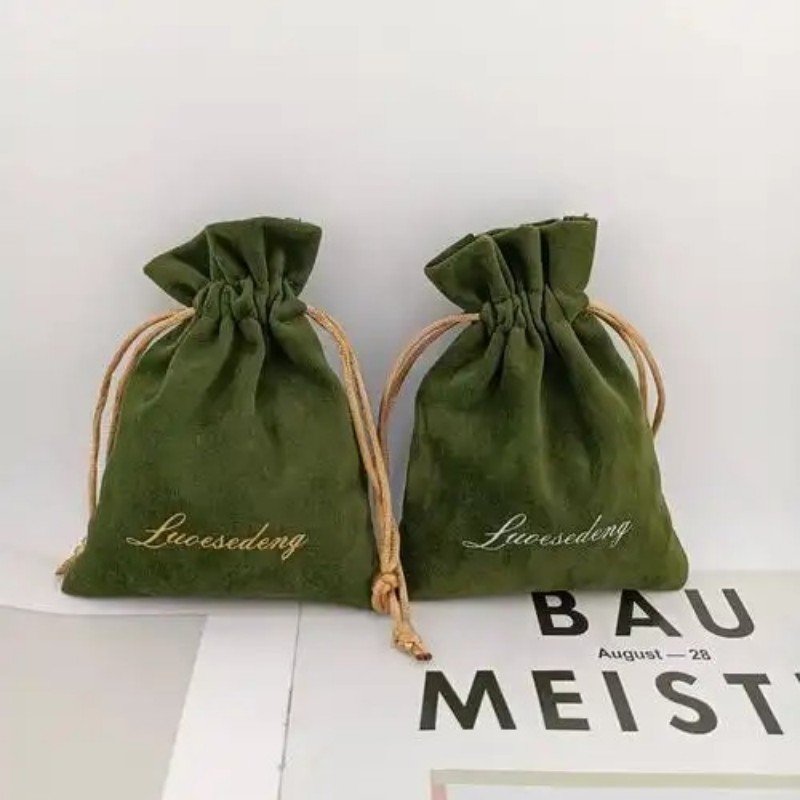
The drawstring pouch (second photo) is product housing, not carry-out. Jewellery, crystals, candles, mini bottles, tea — the pouch becomes the product’s permanent home in a drawer. The formula in the photo is the classic one: natural calico, small single-colour logo, tonal drawcord. Understated at production scale, precious at the unboxing moment.

Both formats share the same superpower: they’re sewn, not moulded. No tooling, no die cost, no MOQ penalty for custom dimensions. That’s why 100-piece custom runs are real here in a way they can’t be for tins or glass.

Specifications
| Attribute | Detail |
|---|---|
| Product | Custom canvas tote bags & cotton drawstring pouches, sewn to order |
| MOQ | 100 pcs per design — no tooling, no die cost |
| Fabrics | Cotton canvas 8/10/12/16 oz · cotton calico 4–6 oz · jute/hessian · rPET canvas · GOTS organic cotton |
| Tote sizes | 30×35 cm (A4 survival) to 45×40+15 cm gusset (full shopper); long or short handles |
| Pouch sizes | 7×9 cm (jewellery) to 20×30 cm (bottles, garments); single or double drawcord |
| Printing | Screen print (water-based / plastisol, 1–6 colours, all-over panels), heat transfer (full colour), DTG digital, embroidery |
| Handles & cords | Self-fabric, cotton webbing, jute rope; box-X reinforced anchor points standard |
| Closure options | Drawcord, toggle cord-lock, zipper, snap, button loop |
| Extras | Inner pockets, base gussets, lining, woven labels, care tags, kraft belly bands |
| Dyes & safety | Azo-free dyes; food-contact documentation for bread/coffee/produce bags |
| Eco options | GOTS organic, recycled cotton, rPET from bottles, traceable sewn-in labels |
| Artwork | AI / PDF / EPS; free mockup in 24 h; pre-production photo sample |
| Lead time | 12–18 days (screen print) · 18–25 days (embroidery / dyed fabric) |
| Shipping | Flat-packed and baled — cheapest freight class of any packaging format |
| Payment / Incoterms | T/T, PayPal; EXW / FOB Ningbo–Shanghai / DDP on request |
Fabric Selection — the oz Guide
Fabric bags are weighed in ounces per square yard (oz), not GSM — divide any GSM figure by ~33.9 to compare. Weight is the single biggest driver of both cost and feel:
| Fabric | Weight | Feel & behaviour | Choose when… |
|---|---|---|---|
| Cotton calico | 4–6 oz | Soft, drapey, economical — the pouch fabric | Drawstring pouches, bread & produce bags, gift wrap alternative |
| Light canvas | 8 oz | Folds perfectly flat, light carry | Event totes, giveaways in volume, retail carry-out |
| Standard canvas | 10 oz | The everyday tote weight — best cost/quality balance | Most branded totes (like the first photo) |
| Heavy canvas | 12 oz | Holds shape when set down, premium hand-feel | Premium retail, merchandise-grade totes |
| Extra-heavy canvas | 16 oz | Stands upright on its own, very rigid | Luxury retail, heavy contents, structured bags |
| Jute / hessian | 10–14 oz | Rustic texture, breathable, coarse | Eco rustic branding, garden & farm products |
| rPET canvas | 10–12 oz | Canvas feel, made from recycled bottles, water-resistant option | “Made from X bottles” story on the label |

Printing & Decoration
| Method | Best for | Notes |
|---|---|---|
| Screen print | Bold logos, 1–3 colours, all-over repeat patterns (both photos) | Cheapest per unit at volume; water-based inks = soft hand-feel, plastisol = max opacity on dark fabric; small screen fee per colour |
| Heat transfer | Full-colour artwork, gradients, photos | Great detail; slightly less “fabric-native” feel than screen ink |
| Embroidery | Premium stitched logos under ~10 cm | Price scales with stitch count, not colours — keep the logo small and dense |
| Digital DTG | Full-colour small runs, no screens | Best on light fabrics; softest feel for photos |
| Woven label / patch | Brand tags sewn into seam or hem | Permanent branding that survives any washing |
Print placement that works
- Tote: centred chest print 25×25 cm is standard; all-over repeats need panel sewing (like the photo) — plan it before cutting, not after.
- Pouch: small front logo 3–5 cm reads best; over-printing a 10 cm pouch makes it look like a giveaway, not a keepsake.
- Sneaky placements that add value: inner-pocket print, drawcord-tipped logo, bottom-of-bag surprise message.
Construction & the Handle Problem
Handles fail before fabric does. Every bag failure photo you’ve ever seen is a torn handle anchor, not a torn body. Our standard construction:
- Box-X stitching at every anchor point — the boxed X-pattern spreads load across the seam; this is what separates a 12 kg tote from a 4 kg one.
- Handles wrapped into the side seam (not just top-stitched on the face) — the load path goes through the body, not the stitch line.
- French-seamed or bound interior edges on premium bags — no fraying threads inside, so the bag reads quality for its whole life.
- Pull-test QC — samples from every batch are hung with rated weight for 1 minute. A tote whose handle rips in the car park costs more in brand damage than the bag cost.
- Drawcord gauge on pouches — cord channel double-turned so the cord can’t tunnel out; cord ends knotted or tipped so they don’t fray.
Size Guide
| Format | Size (cm) | Typical use |
|---|---|---|
| Tote bags | 30 × 35 | A4 survival tote — books, laptop, retail carry-out |
| 38 × 42 | Standard shopper — the everyday format | |
| 45 × 40 + 15 gusset | Full grocery tote, high volume | |
| 25 × 30 | Mini tote / gift bag, events & weddings | |
| Drawstring pouches | 7 × 9 | Rings, earrings, mini charms |
| 9 × 12 / 10 × 15 | Bracelets, candles, mini bottles (photo 2) | |
| 13 × 18 | Necklaces, tea caddies, skincare sets | |
| 20 × 30 | Garments, large bottles, shoe bags |
Custom dimensions are the default, not the upgrade — send measurements or a reference photo, mockup in 24 h.
Shrinkage & Care Rules — Set Expectations Early
- Cotton shrinks 3–5% on first wash. This is the fibre, not a defect. We pre-shrink fabric on request for premium programmes — worth it when a printed pattern must stay aligned after washing.
- Wash inside-out, cold water. The single instruction that doubles print life — print it on the sewn-in care tag.
- Air dry, avoid hot tumble. Heat is what cracks plastisol and shrinks cotton.
- Natural creases are character. Calico and canvas soften and crease with use; brands that embrace this (raw, organic positioning) get a better story than those fighting it.
How Your Bags Are Made (9 Steps)
- Spec & mockup — format, fabric weight, dimensions, decoration; free mockup in 24 h.
- Fabric sourcing — stock rolls for speed, or dyed-to-order / GOTS rolls for premium programmes.
- Pattern & sample — cutting pattern made; pre-production photo sample for approval.
- Screens / embroidery setup — one screen per colour; digitised file for embroidery.
- Panel printing — fabric printed before sewing for edge-to-edge placement (like the all-over tote).
- Cutting — panels cut to pattern, matched to print placement.
- Sewing — box-X anchors, wrapped handles, bound edges per spec.
- QC — handle pull test, print adhesion rub test, dimension check, cord function on pouches.
- Pack & ship — flat-packed in bales; care tags sewn in; belly bands optional.

Applications
| Industry | What we supply |
|---|---|
| Retail & fashion | Branded carry-out totes, merchandise-grade 12–16 oz bags, all-over print designs |
| Jewellery & accessories | Calico drawstring pouches (photo 2), logo prints, tonal cords, sewn-in brand tags |
| Food & beverage | Bread bags, produce bags, coffee pouches with liners — food-contact documentation |
| Candles & home goods | Pouches for candles & diffusers, rustic jute totes |
| Events & weddings | Mini totes, favour pouches, custom colours, fast 100-pc runs |
| Cosmetics | Drawstring sets for gift kits, organic cotton lines |
Canvas vs Non-Woven vs Plastic Bag
| Dimension | Cotton canvas tote | Non-woven PP bag | Plastic carrier |
|---|---|---|---|
| Unit cost (100+) | US$0.80–4.50 | US$0.15–0.60 | US$0.02–0.10 |
| Lifespan (uses) | 100–300+ | 10–30 | 1–10 |
| Brand impressions over life | Thousands — kept for years | Dozens | One or two |
| Premium feel | High — fabric reads quality | Mid — reads promotional | Low |
| Print quality | Screen/embroidery, ages well | Silk-screen, can peel | Flexo, fades |
| Load capacity | 10–15 kg reinforced | 3–8 kg, handle tear risk | Varies, handle tear common |
| End of life | Biodegradable (cotton) / recyclable (rPET) | Difficult to recycle | Recyclable in theory, rarely in practice |
| Regulatory trend (EU plastic bans) | Preferred | Increasingly restricted | Banned in many markets |
| Best role | Brand asset & premium carry | Mid-term promo | Ultra-short-term utility only |
The cost-per-use argument closes the sale: a US$1.50 canvas tote used 200 times costs under 1 cent per impression. A “free” plastic bag used twice costs more than that — and adds to the customer’s guilt instead of your brand.
Frequently Asked Questions
What is the minimum order quantity?
100 pcs per design. Bags are cut and sewn — no tooling — and a single-colour screen print carries only a small screen fee, so 100-piece custom runs are genuinely economical. Unit prices drop substantially at 500, 1,000 and 3,000 pcs.
Which fabric weight should I choose?
8–10 oz for event and retail totes (folds flat, best value), 12 oz for premium everyday carry, 16 oz for structured heavy-duty bags, 4–6 oz calico for drawstring pouches. Divide GSM by ~33.9 to convert to oz.
Which printing method for my logo?
Screen print for bold 1–3 colour logos (cheapest, most durable), heat transfer for full-colour photos and gradients, embroidery for premium small logos, DTG for full-colour small runs. Bold logo → screen; photo → transfer; luxury → embroidery.
Will the print crack or fade after washing?
Quality screen prints survive dozens of washes — inks are cured correctly and wash-tested per batch. Wash inside-out in cold water and print life roughly doubles; we sew that instruction into the care tag.
How much weight can the tote carry?
A 12 oz tote with box-X reinforced handles carries 10–15 kg comfortably. Handles are the failure point, not fabric — every anchor is reinforced and pull-tested per batch.
Can I have a custom size or shape?
Yes — custom dimensions, gussets, inner pockets, zippers and cord gauges are available at 100 pcs with no tooling, because bags are sewn from a pattern, not moulded. Free mockup within 24 hours.
Are the bags food-safe?
Unbleached cotton and calico are the traditional bread, coffee and produce bag materials. Azo-free dyes standard; food-contact documentation available; inner PE or PLA liners available for aroma-critical contents like coffee.
Are there certified organic or recycled options?
GOTS-certified organic cotton, recycled cotton blends and rPET canvas, with traceable sewn-in certification labels. Adds roughly 15–30% to unit cost — for many brands the certification itself is the story.
What is the lead time?
12–18 days for screen-printed stock fabrics; 18–25 days for embroidery or dyed-to-order fabric. Express freight 5–8 days, sea 25–35 days. Bags ship flat-packed and baled — the cheapest freight of anything we make.
OEM & Our Services
JAJA Packing is a packaging supply-chain integrator based in Huzhou, China, coordinating 1,200+ audited partner factories. Bags, boxes, tins and labels in one order — one contact, one invoice.
| Service | Detail |
|---|---|
| Free mockup | Dimensions or reference photo → visual mockup in 24 h |
| MOQ | 100 pcs per design, no tooling; better pricing at 500/1,000/3,000 |
| Sampling | Pre-production photo sample (or physical sample) before bulk |
| Decoration | Screen print, transfer, DTG, embroidery, woven labels — colour-matched to your other packaging |
| Compliance | Azo-free dyes, food-contact documentation, GOTS organic traceable labels |
| Programmes | Pre-shrunk fabric, care tags, retail-ready packing with belly bands & barcodes |
| Reorders | Patterns, screens and artwork stored free — reorder in one message |
| Shipping | Flat-packed bales; EXW / FOB Ningbo–Shanghai / DDP |
Contact: sales1@jajapacking.com · WhatsApp +86 131 2388 3167